A mono-pitch roof only has one slope, but it still needs careful detailing at every exposed edge. If you are asking which flashing suits mono pitch roofing, the short answer is that it depends on where the roof finishes: at a wall, eaves, verge or high edge. The right combination creates a neat, weatherproof finish that keeps wind-driven rain away from sheet laps, timber and insulation.
For sheeted garages, workshops, stables, lean-tos and agricultural buildings, flashings are not an afterthought. They direct water off the roof, protect cut sheet edges and give the building the clean, professional finish it needs.
Which flashing suits a mono-pitch roof?
There is no single flashing that suits every mono-pitch roof. A typical build may need a mono ridge or headwall flashing at the top, eaves flashing at the bottom, and barge flashings down the two sides. Where the roof meets an existing wall, wall abutment or sidewall flashing is normally the key detail.
Your roof pitch, sheet profile, sheet thickness and the direction of the prevailing weather all affect the final specification. The flashing must also work with the roof construction beneath it. A flashing that looks right from ground level can still leak if it does not cover the correct part of the sheet profile or is not sealed and fixed properly.
At the high edge: mono ridge or headwall flashing
For a free-standing mono-pitch roof, the upper edge is often finished with a mono ridge flashing. Unlike a standard ridge flashing used to cover the apex of a dual-pitch roof, a mono ridge is shaped for a single roof slope. It covers the top edge of the roof sheets and provides a smart, weather-resistant termination.
If the high edge runs into a brick, block or timber wall, you will usually need a headwall flashing or an abutment detail instead. The upper section needs to turn up the wall far enough to stop water tracking behind it, while the lower leg must overlap the roof sheets sufficiently. On masonry, the wall flashing may need to be chased into a mortar joint or tucked behind suitable cladding, depending on the construction.
Do not assume a standard ridge cap will do the same job. Its angle, leg lengths and intended fixing position can be wrong for a mono-pitch roof. Ordering the correct purpose-made trim avoids awkward site alterations and gives far better weather protection.
At the low edge: eaves flashing
At the bottom of the slope, fit eaves flashing or a drip trim. This guides rainwater into the gutter rather than allowing it to run back onto the fascia, into the roof build-up or down the face of the wall.
The detail matters most on shallow pitches, where water moves more slowly and can be pushed uphill by strong winds. The roof sheets should project into the gutter by the right amount, while the eaves flashing supports a clean drip line. Too little overhang can leave water behind the gutter. Too much can make the sheet edge vulnerable in high winds.
Eaves flashings should be considered alongside fillers, closures and anti-condensation measures. The trim deals with rainwater outside the roof, but it cannot solve condensation forming beneath uninsulated metal sheets.
Along the sides: barge or verge flashing
The exposed side edges of a mono-pitch roof need barge flashings, sometimes called verge flashings. These sit over the sheet edge and protect the roof from wind-driven rain entering beneath the side lap or profile edge.
Barge flashings are especially useful on detached sheds, garages and farm buildings where the roof sides are fully exposed. They also improve the appearance of the installation by concealing the cut edge and giving the roofline a crisp, finished look.
The flashing should suit the direction of the sheet profile and allow a proper overlap onto the roof sheet. On box profile and corrugated sheets, the shape must sit correctly over the ribs or corrugations. A flat trim forced over a deep profile is unlikely to seal well without the appropriate profile fillers.
Where a mono-pitch roof meets a wall: abutment flashing
A lean-to roof is one of the most common mono-pitch applications. In this case, the critical flashing is usually the wall abutment flashing. It may be fitted at the top of the roof, along one side, or both, depending on how the extension or canopy meets the existing building.
An abutment flashing needs enough upstand against the wall and enough cover over the roofing sheets. The wall detail above it is equally important. If rain can get behind the top edge, it will eventually find its way into the building. For this reason, a properly formed chase, cover flashing or compatible cladding detail is preferable to relying on sealant alone.
Choose flashings to match the roof sheet profile
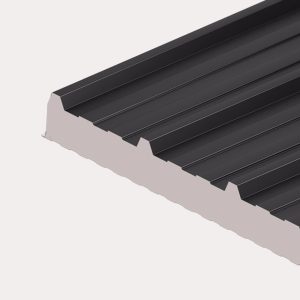
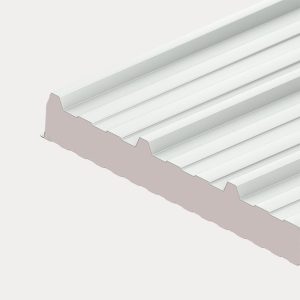
The best flashing is not simply the one with the right name. It must suit the roof sheets you have chosen. Box profile, corrugated, tile-effect and insulated composite panels all have different shapes and depths, so their closures and overlaps are different too.
For a metal sheet roof, choose flashings in a compatible material and coating wherever possible. Colour-matched steel flashings give a consistent finish and are a practical choice for most domestic, agricultural and light industrial projects. They are sleek, strong and made to stand up to British weather when specified and fitted correctly.
Take care when combining dissimilar metals. Some combinations can accelerate corrosion when moisture is present. This is also why fixings, washers and sealants should be suitable for the sheet coating and flashing material.
Length is another practical consideration. Longer flashings can reduce the number of joints, but they need safe handling and may be more difficult to manoeuvre on a tight site. Where two sections join, maintain the recommended overlap and seal the lap so water cannot be driven underneath.
Fitting details that make the flashing work
Even precision-crafted flashings can fail if the roof is not prepared properly. Before fixing, check that the sheets are square, the eaves line is straight and the purlins or supporting timbers are in the right position. A twisted roof edge makes it difficult to achieve even cover and can leave gaps at sheet ribs.
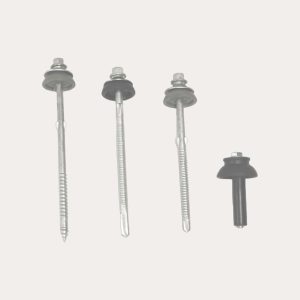
Use compatible stitching screws or roof fixings at the correct centres. Avoid over-tightening them, as this can distort the flashing, crush the washer and create a route for water. Where the manufacturer recommends butyl tape, foam fillers or sealant strips, use them. These small components are often what stop wind-blown rain entering at profile gaps.
Pay close attention to sheet end laps, side laps and flashing laps. Water should always be encouraged to flow over the next component, not towards an exposed joint. At wall abutments, keep sealant as a secondary line of defence rather than the only barrier against rain.
Common mono-pitch flashing mistakes
The most frequent mistake is ordering only a ridge flashing and overlooking the verge, eaves and wall details. A roof can look complete from one angle yet still have several unprotected edges.
Another is choosing a generic trim without confirming its dimensions. Measure the roof pitch, sheet profile depth, required cover over the roof sheets and height needed against the wall. This is particularly important where insulation, rooflights or existing cladding change the finished roof level.
Finally, do not use flashing to compensate for an unsuitable roof pitch. Every sheet system has minimum pitch guidance, and low-pitch roofs demand more care with laps, sealants and water run-off. If the roof is close to the minimum, getting the correct trims and closures is even more important.
Get the whole roof detail right before ordering
A weatherproof mono-pitch roof is a system: sheets, fixings, fillers, flashings, gutters and the structure beneath all need to work together. Before placing an order, sketch the roof edges and mark each location where the sheets finish, meet a wall or change direction. This quickly shows whether you need mono ridge, eaves, barge or abutment flashings – often more than one type.
Roof Sheets Online can help customers match flashings, fixings and closures to their chosen sheet profile, so there is less chance of losing time on site with the wrong trim. A few accurate measurements and a clear description of the roof layout are usually enough to get the detail moving in the right direction.
The best flashing for a mono-pitch roof is the one designed for that exact edge, profile and junction. Specify it before the sheets arrive, and the final roof will be far easier to fit, stronger in poor weather and properly finished from every angle.