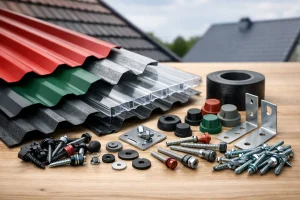
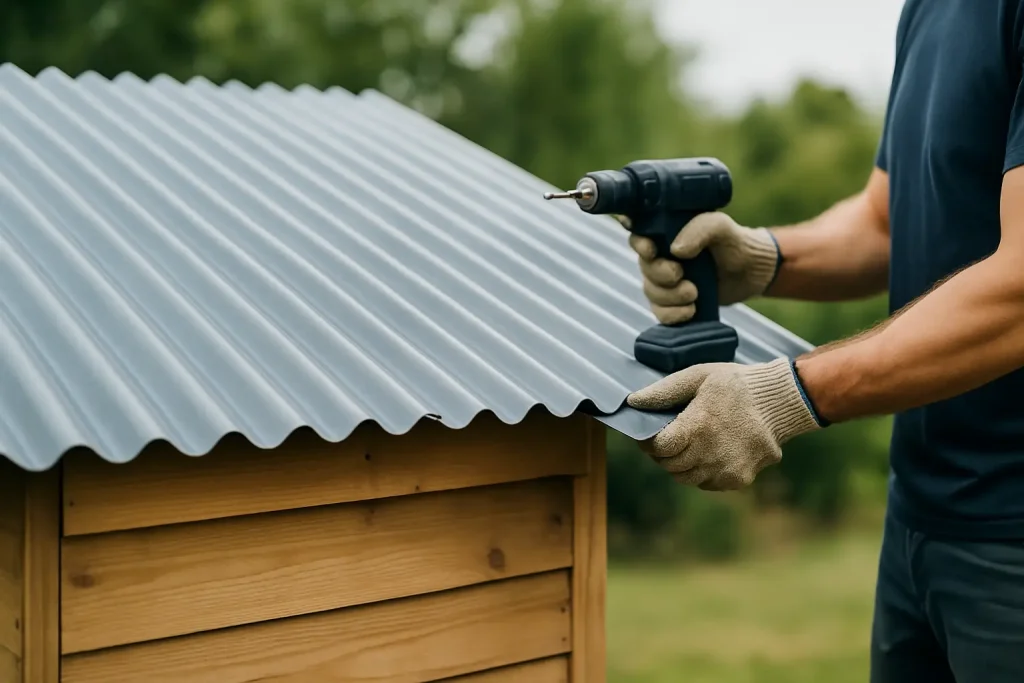
If your shed roof has ever dripped on your tools after a cold night, you already know the job is not just “stick some sheets on and hope”. A shed is a small roof, but it still takes the full force of British weather – wind uplift, driven rain, winter condensation and summer heat. The right corrugated roofing sheets for shed projects make the difference between a dry, tidy workspace and a yearly repair.
Corrugated profile earns its place on sheds for simple reasons: it sheds water quickly, it has good spanning strength for its weight, and it’s forgiving on small buildings where timber framing is rarely perfectly straight. The curved profile also helps resist buckling, which is handy when the roof sees temperature swings.
That said, corrugated is not a magic fix. Most early failures come from the wrong material choice, too little fall, poor laps, or the wrong fixings. Get those right and a corrugated roof is a solid, long-life option for workshops, stores, log sheds, tack rooms and field shelters.
The first decision is not the profile – it’s the material. Corrugated is available in several types, each with its own trade-offs.
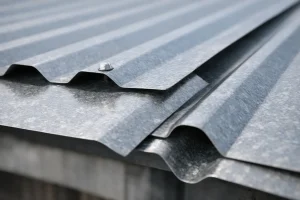
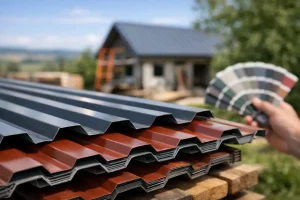
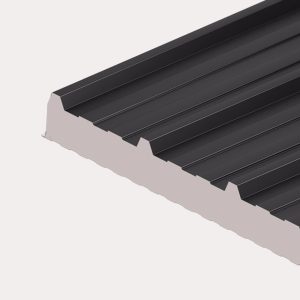
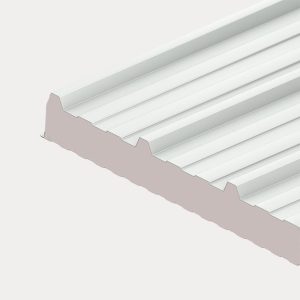
Steel is the go-to when you want strength and long-term value. A coated steel sheet (polyester or Plastisol) gives you better corrosion resistance than bare galvanised and tends to look smarter on a garden-facing building. Plastisol is thicker and generally more forgiving in harsh environments, while polyester is a strong value option.
Steel does need correct detailing. Cut edges and drilled holes are where corrosion starts, so neat cutting, proper washers, and touch-up paint where appropriate all matter. It’s also louder in heavy rain than fibre cement and it will condense if you don’t manage moisture.
Fibre cement is a classic on sheds, stables and agricultural outbuildings. It’s quieter in rain, more stable in temperature change, and less prone to condensation dripping. It also feels more “solid” and is often chosen where the building houses animals or feed.
The trade-off is weight and handling. It’s heavier than steel and needs careful drilling and fixing to avoid cracking. If you’re working alone, think about sheet size and safe lifting.
Bitumen is light and easy to cut, often used for quick shed builds. The compromise is durability. It can soften in high heat, it doesn’t stay as crisp-looking over time, and wind resistance depends heavily on your fixing pattern and support spacing.
Clear or tinted corrugated sheets are useful when you want daylight inside without fitting a separate rooflight. Polycarbonate is tougher than PVC and generally a better long-term choice.
Be realistic: translucent sheets expand and contract more than steel. They need the correct oversized holes, the right fixings, and they don’t like being overtightened.
A shed roof often has a shallow pitch. That’s fine, but you need to respect the minimum falls for the sheet type and the lap detailing.
If your roof is close to flat, water drains slower and laps do more work. That means you should increase the end lap, use side laps correctly, and consider sealing tape where exposure is high. If you can increase the pitch even slightly during the build, you make the whole roof more forgiving.
Sheet length is the next big win. Where possible, use sheets long enough to run from eaves to ridge in one piece. Every end lap is a potential leak point, especially on a small roof where the wind can push rain up under the lap.
When you do need an end lap, don’t guess it. Your lap length should suit the pitch and exposure. A sheltered garden shed can be less demanding than a field shelter on an open site, and it’s the open sites that punish lazy laps.
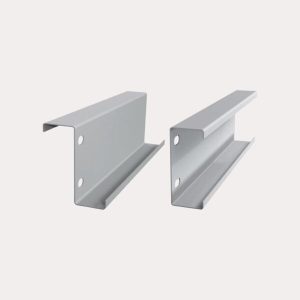
Corrugated sheets are strong for their weight, but they are not a substitute for decent framing. Your purlin or rafter spacing should match the sheet type and thickness.
Too wide a span leads to “oil-canning” (visible flexing), fastener strain, and leaks around fixings. It can also cause ponding on shallow pitches, which then accelerates corrosion and lap problems. If you’re refurbing an old shed, check the existing timber is straight, sound, and properly supported before you blame the sheets.
Most shed roof leaks start at fixings, not the middle of a sheet.
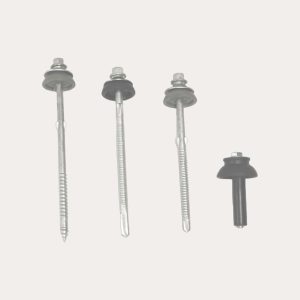
For steel corrugated roofs, use the correct roofing screws with bonded washers, matched to timber or steel supports. Place fixings where the sheet profile and manufacturer guidance requires – commonly on the crest for many metal profiles to keep the washer out of standing water, but always follow the specific recommendation for the sheet you’re using.
Avoid mixing random screws from the garage. Incorrect thread type strips out timber; incorrect washer type perishes; incorrect length fails to bite properly. Overtightening is just as bad as undertightening – you can split the washer, deform the sheet, and create a capillary path for water.
For fibre cement, pre-drilling and using the correct bolts and sealing washers is key. The sheet needs to be held securely without point-loading it.
Corrugated roofing is not just sheets. You need to think about how wind-driven rain behaves at the edges.
Side laps should be consistent across the roof so the water line is predictable. End laps should land on a support, not float between timbers. At the eaves, a simple detail like an eaves filler or closure can stop wind pushing rain up the corrugations and into the shed.
If your shed roof meets a wall (for example a lean-to against the house, garage or workshop), don’t rely on mastic alone. Use proper flashings and a clean overlap. Sealants have their place, but good metalwork is what makes the job last.
If you’re fitting a ridge on a dual-pitched shed, don’t skip the ridge pieces and expect two sheets to “kiss” neatly. A ridge flashing not only keeps water out, it stiffens the roof line and improves wind resistance.
A shed is often unheated but damp inside: wet tools, green timber, soil on boots, maybe even a dryer vent nearby. That moisture rises and hits the underside of a cold roof.
Steel roofs are the most likely to drip. You can reduce it by improving ventilation (high and low vents), keeping stored items off the floor, and avoiding blocking airflow with insulation that has no vapour control layer.
If the shed is a workshop you use year-round, consider anti-condensation backing on metal sheets or a properly designed insulated build-up. It costs more upfront, but it stops the steady drip that ruins timber benches, electrics and stored materials.
Fibre cement naturally handles condensation better, which is why it’s popular on stables and stores, but it’s not a cure-all if the building is constantly wet inside.
A dark shed is hard to work in. Adding a rooflight sheet or a couple of translucent corrugated sheets can transform it, but you need to treat them as a different material.
Allow for expansion, use the correct fixings, and don’t overtighten. Put them where you can support them properly and where you won’t be walking. If you want a brighter space without compromising strength, a dedicated rooflight panel designed to match the profile is often a cleaner option than cutting and patching.
Shed roofs feel small, but they’re easy to mis-order because every roof is “nearly” square.
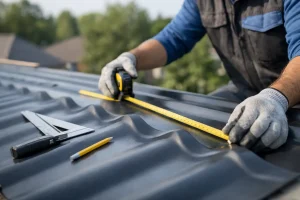
Measure the roof length along the slope (not just the footprint), then allow for overhang at the eaves. Work out your effective cover width per sheet after side laps, not the overall sheet width. If you’re using verge flashings, ridges, bargeboards, closures or sealing tapes, factor those in early rather than improvising on install day.
If you want a single order that includes the sheets and the supporting components in one delivery, Roof Sheets Online Ltd supplies corrugated profiles alongside fixings, flashings, purlins, rooflights and the finishing accessories that make a shed roof properly weatherproof – with phone-backed support if you want a second pair of eyes on the spec.
It depends on what the shed is doing.
If it’s a garden store and you want a crisp finish that lasts, coated steel corrugated is a strong choice, provided you handle condensation sensibly. If it’s an animal or feed store where quieter performance and moisture control matter, fibre cement is often the practical pick. If budget and speed are the driver, bitumen can work, but only if you respect support spacing and fixings so the first gale doesn’t find the weak points.
A shed roof is one of those jobs where the details pay you back every time it rains. Build it as if it was a bigger roof: correct pitch, correct laps, correct fixings, and a plan for moisture. Your future self, opening a dry shed door in February, will thank you.
Roof Sheets Online Ltd
UNIT C4
MACROME ROAD
Wolverhampton
WV6 9HD
Company No 15150940
Vat No. 4880 70856