A leaking roof sheet rarely fails in the middle of a dry spell. It shows up when wind-driven rain starts finding weak points around laps, fixings, flashings or ridge details. Choosing the best sealants for roof sheets is not just about grabbing the nearest tube off the shelf. The right product depends on the sheet material, the joint design, how much movement the roof sees, and whether you are sealing a fresh install or trying to stop an existing leak.
Get that choice right and you create a tidy, weatherproof detail that lasts. Get it wrong and the sealant may peel away, crack, trap water or simply fail to bond where you need it most. For trade buyers and competent DIY installers alike, the key is matching the sealant to the job rather than expecting one product to solve every roofing problem.
Roof sheets move. Steel expands and contracts, bitumen-backed laps can shift slightly, fibre cement has its own characteristics, and flashings often bridge different materials. That means a roof sealant needs more than basic stickiness. It needs good adhesion, flexibility, weather resistance and enough durability to cope with UV, rain and temperature changes across the seasons.
It also needs to suit the detail you are sealing. A side lap on corrugated sheeting needs something different from a flashing chase or a fixing penetration. In many cases, the best answer is not a generic decorator’s sealant but a roofing-specific product designed for external use and long-term exposure.
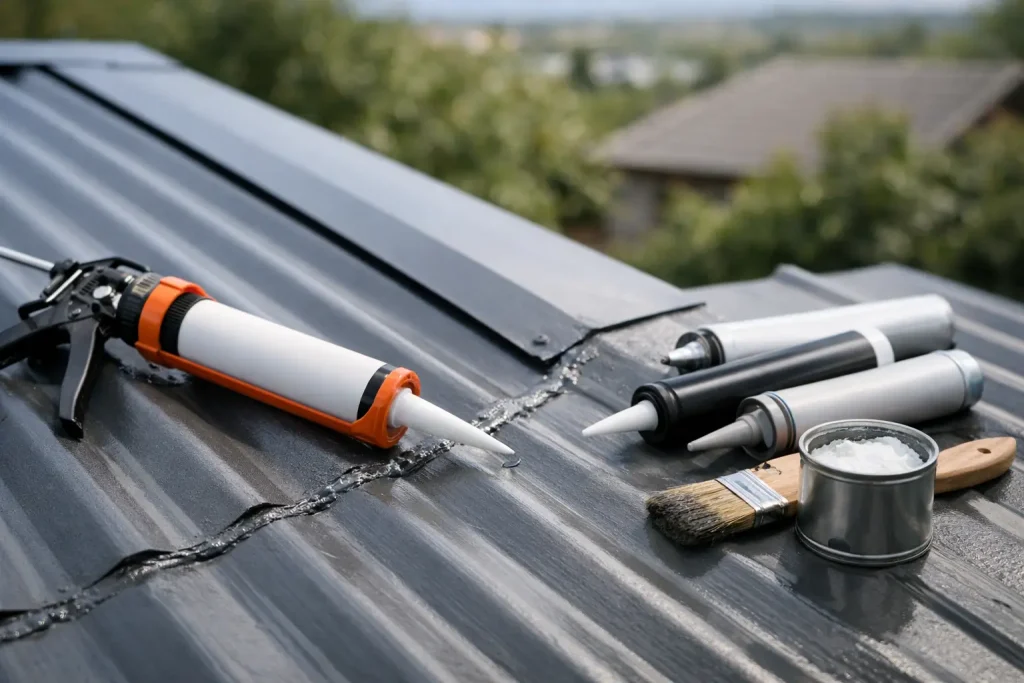
The main options usually come down to butyl tape, gun-grade butyl, neutral cure silicone, polyurethane sealant and specialised roof repair compounds. Each has strengths, and each has limitations.
For many sheeted roofs, butyl tape is one of the most reliable choices. It is especially effective between overlapping roof sheets, around side laps and end laps, and beneath flashings where the joint is mechanically compressed. Rather than curing hard, butyl stays tacky and flexible, which helps it maintain a seal even as the roof moves slightly over time.
This is why butyl is often the first choice on metal roofing installations. It works well where sheets are fixed down firmly and the sealant is not expected to bridge a wide exposed gap on its own. If you are fitting box profile or corrugated sheets, a good quality butyl lap tape is usually a smarter option than squeezing silicone between the sheets and hoping for the best.
The trade-off is that butyl tape needs a clean, dry surface and proper compression. If the lap is uneven, dirty or loosely fixed, performance drops off quickly. It is also not the right product for every visible repair, because it is better suited to concealed joints than exposed finishing work.
Where tape is too rigid or awkward to apply, gun-grade butyl sealant can be a very practical alternative. It is useful around penetrations, trims, verge flashings and uneven lap details where you need the same broad performance benefits of butyl but with easier application.
Gun-grade butyl remains flexible and has strong adhesion to many common roofing materials, including coated steel and galvanised components. It is particularly handy on refurbishment work, where older roofs are rarely perfectly straight and uniform.
That said, it is not usually the tidiest finish if you need a very clean exposed bead. It can pick up dirt more readily than some cured sealants, so it is best used where performance matters more than appearance.
A quality neutral cure silicone is often one of the best sealants for roof sheets when you are sealing exposed external joints, especially around flashings and perimeter details. It offers good weather resistance, handles UV well and remains flexible once cured.
Neutral cure matters. Some silicones release acetic acid as they cure, which can be a poor match for certain metals and coatings. On roofing work, neutral cure products are generally the safer choice for compatibility and long-term performance.
This type of sealant can work well on coated steel, aluminium and many flashing details, but it is not always ideal for compressed sheet laps. In those situations, butyl often gives a more dependable seal. Silicone is better thought of as a finishing and jointing sealant rather than a cure-all for every overlap in the roof.
If appearance matters, silicone usually gives a neater bead than butyl. Just make sure the surfaces are properly prepared and that you are not applying it to a wet, dirty or unstable substrate.
Polyurethane, often shortened to PU, is a strong all-round roofing sealant where adhesion and toughness are priorities. It bonds well to many construction materials and is often used for flashings, trims, penetrations and joints that may see more mechanical stress.
Compared with silicone, PU can offer a tougher finish and can sometimes be painted, depending on the product. That can be useful on visible detailing. It also tends to grip well where surfaces are less than perfect, though proper preparation still matters.
The downside is that PU is not always as easy to tool neatly, and some products are less UV-stable than premium silicone unless they are specifically formulated for external roofing use. It is a good option, but only when the product specification fits exposed roof conditions.
There are also thick, repair-focused sealants and compounds marketed specifically for emergency roofing jobs. These can be useful for temporary repairs, awkward patching and sealing around problem areas on older roofs. Some can even be applied in damp conditions, which helps when a leak cannot wait for perfect weather.
They have their place, especially in maintenance work, but they are rarely the best long-term answer for a properly installed sheeted roof. If the original issue is a failed lap detail, incorrect fixing pattern, poor flashing design or a damaged sheet, a repair compound may only buy time.
For a lasting result, it is better to treat the cause rather than keep layering products over the symptom.
Metal roof sheets, including box profile and corrugated steel, generally respond best to butyl tape at overlaps and a compatible neutral cure silicone or PU sealant at trims, flashings and penetrations. These roofs expand and contract noticeably, so flexibility matters.
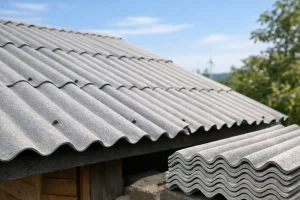
Fibre cement sheets need a little more care. The surface can be dustier and more porous, and not every sealant bonds equally well. A compatible external-grade sealant designed for building movement is usually the safest route, but preparation is critical. Loose surface dust or dampness will undermine even a premium product.
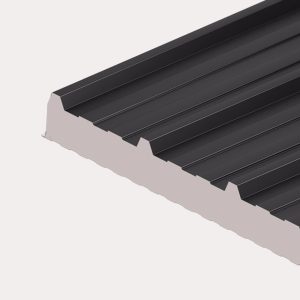
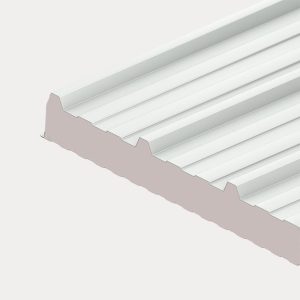
Insulated panels are another case where the detail matters. The outer sheet, liner, joint profile and manufacturer guidance all affect which sealant should be used and where. With insulated systems, using the correct jointing and sealing products is especially important because water ingress is only one concern. Air leakage and thermal performance matter too.
Even the best sealant will fail if it is applied badly. Roofing sealants need clean, stable surfaces. Old loose sealant should be removed, dirt and oxidation cleaned off, and the joint should be dry unless the product specifically allows damp application.
Bead size matters too. A bead that is too thin can split as the roof moves. Too much sealant can be just as unhelpful, particularly in laps where it prevents the sheets from seating properly. On lap tapes, correct positioning is essential. Place it where compression will happen once the sheets are fixed, not randomly across the overlap.
Temperature also affects performance. Very cold conditions can make some products harder to apply and reduce initial tack. In hot weather, skins can form quickly. A steady, methodical approach usually gives the best result.
The biggest mistake is using general-purpose silicone where a roofing-grade butyl or external sealant is needed. Another common problem is trying to seal a moving or poorly supported joint instead of correcting the detail itself. If a flashing is loose or a sheet is under stress, no sealant will compensate for bad installation.
Over-sealing is also common. More product does not automatically mean better weatherproofing. In some cases, heavy-handed sealing traps water or hides the route of a leak without stopping it.
Compatibility gets overlooked too. Not every sealant suits every coating, sheet type or accessory. If you are working with coated steel, fibre cement, rooflights or insulated panels, it pays to check that the sealant is intended for that use.
If you want the most dependable answer, butyl lap tape is often the best choice for sheet overlaps, while neutral cure silicone or a roofing-grade PU sealant is often better for exposed flashings, edge details and penetrations. For repairs on older roofs, gun-grade butyl and specialist repair compounds can be useful, but they work best when used for the right problem.
There is no single winner for every roof. The best sealants for roof sheets are the ones that match the sheet profile, joint type and site conditions, and that are applied properly alongside the correct fixings and flashings. That is why buying roofing materials as a complete system makes life easier. When sheets, trims, fixings and sealing products are specified together, you are far less likely to end up with gaps, compatibility issues or a rushed repair later on.
If you are unsure which sealant fits your project, whether it is a garage, stable, workshop or full roof refurbishment, it is worth asking before you order. A straightforward bit of technical advice at the start usually saves a lot of time on a ladder later.
Roof Sheets Online Ltd
UNIT C4
MACROME ROAD
Wolverhampton
WV6 9HD
Company No 15150940
Vat No. 4880 70856