If you get the sheet count right but the fixings wrong, the roof can still fail. That is why one of the most common questions we hear is how many fixings per roofing sheet you actually need. The honest answer is not one fixed number for every job – it depends on the sheet profile, sheet length, support centres, site exposure and whether you are fixing roof sheets or wall cladding.
Use too few fixings and you risk sheet movement, wind uplift and water ingress. Use too many and you can waste money, distort the sheet or create unnecessary penetrations. A good fixing pattern gives you a roof that is secure, weather-resistant and neat, without overdoing it.
For most steel roofing sheet installations on typical outbuildings, garages, workshops and agricultural buildings, a common guide is around 8 to 12 fixings per sheet. That said, this is only a starting point, not a rule that suits every profile and span.
A short sheet on close purlin centres may need fewer than a longer sheet crossing more supports. A box profile roof sheet fixed over several purlins will naturally need more fixings than a single-slope lean-to with limited spans. Exposed sites, coastal locations and taller buildings may also call for a tighter fixing pattern, particularly at sheet ends, laps and edge zones where wind loads are higher.
That is why experienced installers work from the sheet type and support layout first, then calculate fixings from there. Counting by sheet alone can be misleading.
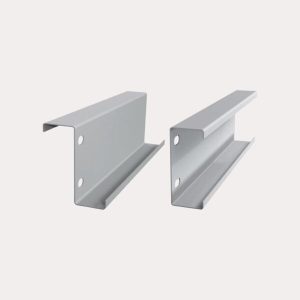
The easiest way to estimate fixings is to look at how many support lines each sheet crosses. In most metal roofing applications, fixings are driven through the sheet into the purlins beneath. So if a sheet runs across four purlins, your fixing total will be based on those four support points.
As a practical example, a standard box profile sheet might be fixed at each purlin line through selected crowns, not every crown across the full width. On internal purlins, the fixing pattern is often lighter than at the top and bottom ends of the sheet. Eaves and ridge areas usually need more attention because those points see greater wind effect and sheet edge movement.
That means two sheets of the same size can use different fixing quantities if one roof has wider purlin centres or a different fixing specification.
On many installations, the sheet is fixed into the main supports at regular intervals across the width, with extra fixings at overlaps and perimeters. Side laps may also require stitching screws, especially on lower pitches or longer sheet runs where weather-tightness matters more.
In simple terms, you are usually allowing for three things at once: main sheet-to-structure fixings, side lap stitching fixings, and any additional fixings required at edges, ridges or flashings. When people ask how many fixings per roofing sheet, they often mean the main fixings only, but the full roof fixing count is usually higher once all accessories are included.
Not all roofing sheets are fixed in the same way. Box profile, corrugated, fibre cement and insulated panels each have their own fixing positions, washer requirements and support recommendations.
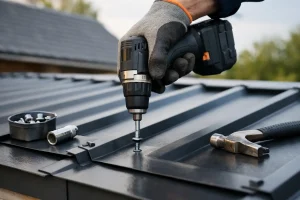
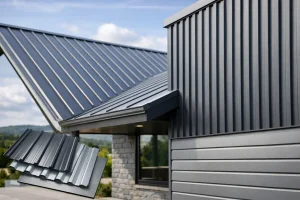
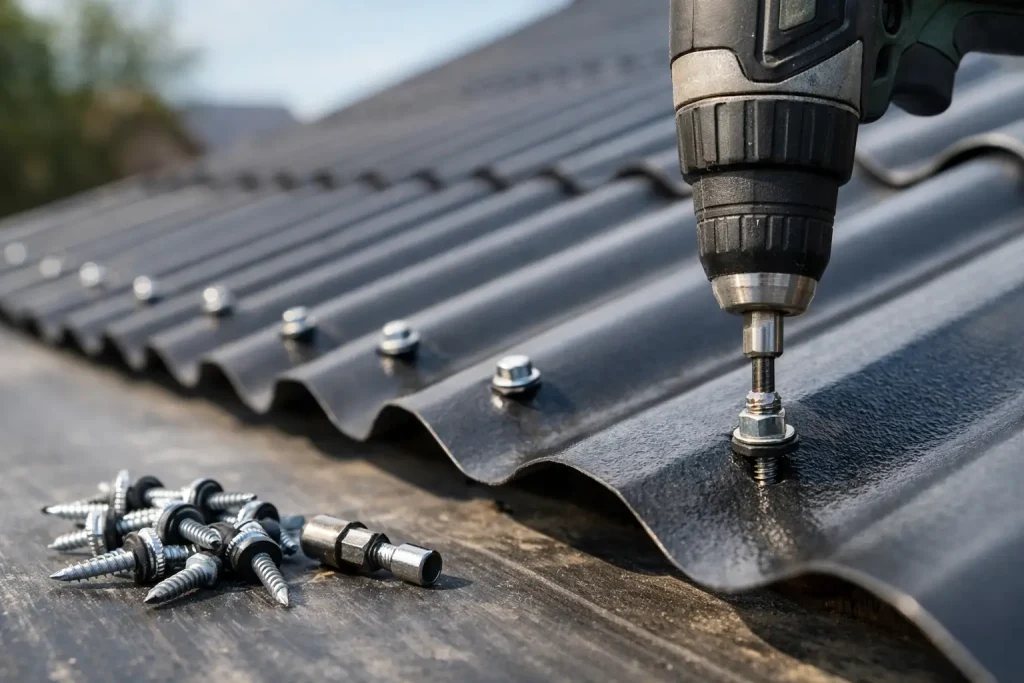
Box profile sheets are one of the most common choices for garages, sheds, workshops and commercial units. They are sleek, strong and weather-resistant, but they must be fixed correctly through the right part of the profile using suitable self-drilling fasteners and sealing washers. The number of fixings can vary with the profile width and support layout.
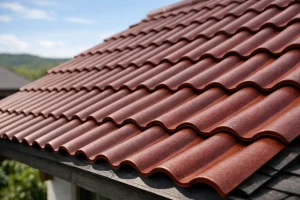
Corrugated sheets often follow a different pattern because of the rounded profile shape. Fixing positions and lap details are not the same as box profile, so it is not safe to assume one layout suits both.
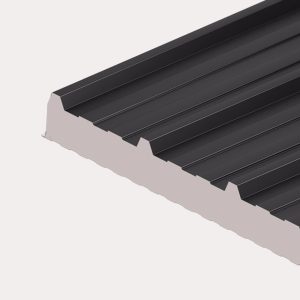
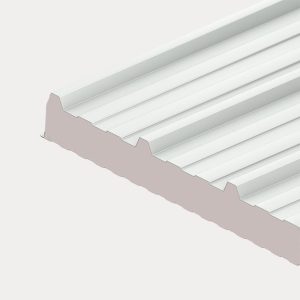
Fibre cement sheets are different again. They typically require specialised fixings and support considerations, and over-tightening can damage the sheet. Insulated panels also need a more precise approach because panel thickness, liner, outer sheet and support structure all affect the correct fastener length and specification.
If you are mixing sheet types across a project, treat each area on its own merits.
For a standard box profile roofing sheet on a straightforward domestic or light commercial roof, many installers will end up somewhere around 8 to 10 main fixings per sheet, sometimes more on longer lengths or exposed sites. Add stitching screws for side laps, and the total per sheet area rises.
For example, if the sheet crosses four purlins and the fixing pattern calls for two or three fixings across each support line, the total quickly lands in that range. If the sheet is longer and crosses five or six purlins, you can expect the quantity to increase.
This is why buying fixings purely by sheet count can catch people out. A 10-sheet roof does not automatically need 100 fixings. It may need more once you account for support lines, lap stitching and flashings.
These smaller screws are often missed when people price a job. Main fixings secure the sheet to the purlins, but stitching screws pull overlapping sheets together along the side lap. Without them, the lap can flutter, open slightly under wind pressure, or become less reliable against driven rain.
The spacing for stitching screws depends on the sheet profile and roof pitch, but they are a standard part of many profiled metal roof installations. If you are working out a full order, include them from the start rather than treating them as an afterthought.
The biggest mistake is assuming every sheet takes the same number of fixings regardless of length. A 2 metre sheet and a 5 metre sheet rarely use the same fixing quantity because the longer sheet normally crosses more supports.
Another common issue is ignoring edge zones. Sheets at the gable end, eaves and ridge may need closer fixing than sheets in the middle of the roof. Wind uplift is not spread evenly across the building, and edge sheets are often under greater stress.
It is also easy to forget the accessories. Ridge flashings, bargeboards, foam fillers and closures can all affect the final fixing requirement. If the roof includes rooflights, that adds another layer of detail because the fixing arrangement may differ from the steel sheets beside them.
Then there is over-fixing. More screws do not automatically mean a better roof. If fixings are placed incorrectly or driven too tightly, you can compress washers, deform the profile and reduce weather performance rather than improve it.
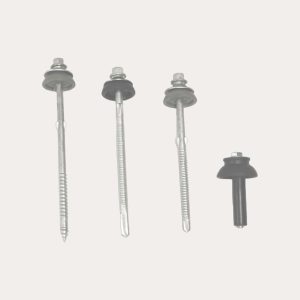
Getting the number right is only half the job. The fixing itself must suit the sheet and the substrate beneath it. Timber and steel supports require different fasteners, and the wrong thread type or drill point can slow the install or compromise the hold.
You also need the right washer and coating. A proper roofing fixing should create a firm, weatherproof seal without damaging the sheet finish. Cheap or unsuitable fasteners are a false economy, especially on roofs exposed to regular rain, frost and wind.
This is where buying the full system from one specialist supplier can save time. Matching sheets, flashings, closures and fixings properly from the start avoids last-minute substitutions and site delays.
If you want a reliable estimate, work backwards from the roof layout. Start with the number of sheets, then check the sheet length, support centres and number of purlins each one crosses. After that, add the side lap stitching screws and any flashings or trims.
For many straightforward projects, that process gives a much more realistic total than using a rough per-sheet guess. It also helps avoid under-ordering, which is one of the easiest ways to hold up a roof install.
If you are unsure, ask for guidance before ordering. At Roof Sheets Online, that is often the difference between a smooth installation and a second delivery for missed components. A few minutes spent confirming the correct fixing pattern can save a lot of time once the sheets are on site.
Some projects need a more technical fixing schedule. Coastal exposure, high altitude sites, unusually low pitches, heavy-duty industrial applications and insulated panel systems all deserve a closer look. In those cases, the answer to how many fixings per roofing sheet is not a quick rule of thumb. It needs to reflect the building design and the system being installed.
That is especially true when roof performance matters beyond basic weather cover. If condensation control, thermal efficiency and long-term durability are priorities, every part of the build-up needs to work together, including the fixings.
A roof sheet should never be treated as a standalone item. It is part of a complete roofing system, and the fixings are what hold that system together under real conditions.
If you are planning a new roof or a refurbishment, treat fixing quantities as part of the specification, not a last-minute add-on. Get the sheet profile right, match the fasteners to the structure, and allow for laps and edges properly. That way the finished roof is not just fitted – it is built to stay put.
Roof Sheets Online Ltd
UNIT C4
MACROME ROAD
Wolverhampton
WV6 9HD
Company No 15150940
Vat No. 4880 70856