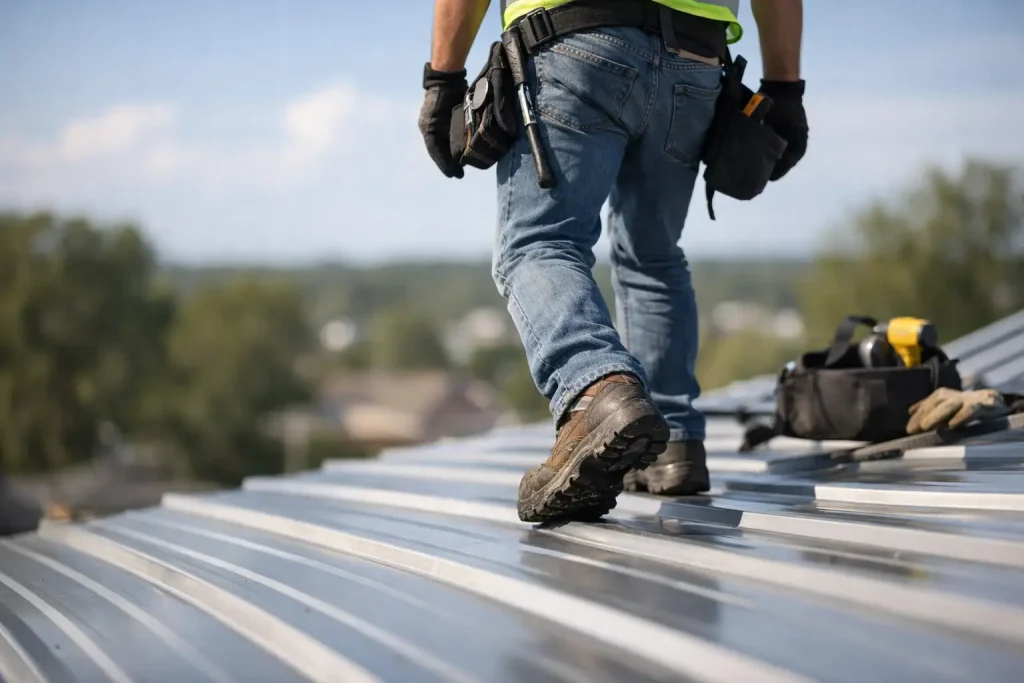
A quick step in the wrong place can dent a sheet, crack a rooflight, or put you through the roof. So, can you walk on metal roofing sheets? Yes – but only in the right way, on the right roof, and with proper support beneath the sheet. That distinction matters whether you are fitting new sheets on a garage, carrying out maintenance on a workshop, or checking flashings on an agricultural building.
Metal roofing is strong, weather-resistant and built for long service life, but sheet strength is not the same as safe foot traffic everywhere across the roof. Profile, thickness, sheet span, substructure, pitch and weather all affect whether it is safe to walk on it. If you treat every metal roof as fully walkable, you can damage the roof and put yourself at risk.
You can walk on metal roofing sheets safely in some situations, but not all. The safest answer is that you should only step on a metal sheet where it is properly supported by purlins or the roof structure beneath, and only if the sheet profile and gauge are suitable for foot traffic during installation or maintenance.
This is where many problems start. People see steel roofing and assume it is strong enough to take body weight anywhere. In practice, the unsupported pan of a sheet can flex, deform or buckle under load, particularly on lighter gauges or wider spans. Even if it does not fail dramatically, a poor step can leave visible dents, affect drainage, or weaken the coating over time.
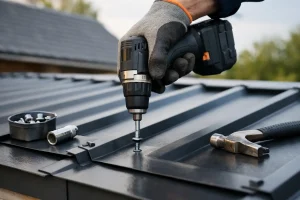
For most profiled metal sheets, foot traffic should be limited and controlled. During installation, experienced fitters typically step carefully over structural supports and avoid placing full weight in weak points. That is very different from walking casually across the roof as if it were a solid deck.
In general, you should step over or very close to the purlins, where the sheet is supported from below. On many profiled sheets, that means placing your foot in line with the structural support rather than in the middle of an unsupported span.
The exact stepping point depends on the profile. Box profile and corrugated sheets behave differently, and the manufacturer guidance for the specific sheet should always take priority. Some profiles distribute load better than others, but none should be treated as foolproof underfoot.
If you are handling long sheets during fitting, use crawl boards or roof ladders where appropriate and keep movement controlled. The goal is simple – spread the load, stay on supported areas, and avoid sudden weight transfer.
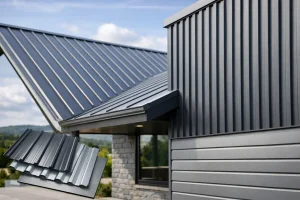
Box profile roofing sheets are commonly used on garages, workshops, industrial units and agricultural buildings. They are strong and popular for a reason, but you still should not walk wherever you like. The sheet needs support beneath it, and the deeper profile does not mean every flat section is safe to stand on.
Where installers do need to step on box profile sheets, it is usually done near the purlins and with care to avoid distorting the profile. If you are not sure where the support lines are underneath, stop there. Guessing is how sheets get damaged.
Corrugated sheets can be durable and practical, especially on traditional and agricultural-style buildings, but walking on them still needs care. Their curved profile gives strength, yet unsupported sections can still flex under concentrated load.
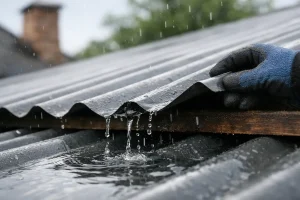
As with other metal sheets, supported areas are key. Wet corrugated roofing can also be especially slippery, which turns a minor mistake into a serious hazard very quickly.
The big factor is support. A properly installed sheet fixed to correctly spaced purlins is very different from a lightly supported sheet with a wide span. Sheet thickness matters too. Thicker steel sheets generally cope better with controlled foot traffic than thinner alternatives, but thickness alone does not make a roof safe to walk on.
Profile shape also plays a part. Some profiles are inherently stiffer than others. Roof pitch changes the risk as well, because steeper roofs are harder to move across safely and increase slip potential. Then there is the weather. Rain, frost, condensation, algae, dirt and loose debris can make a metal roof treacherous even when the sheet itself is structurally sound.
Condition matters just as much as specification. An older roof with corrosion, loose fixings, damaged sheets or degraded rooflights should never be treated the same as a new installation. Age and wear reduce your margin for error.
If the sheets are wet, icy or visibly damaged, do not walk on them. If the roof includes rooflights, avoid stepping on or near them unless there is proper edge protection and a safe access plan. Rooflights are a major fall risk because they do not always look dangerous from above, especially on older roofs with dirt or fading.
You should also avoid walking on metal roofing sheets if you do not know the support layout underneath. Unsupported sections are where denting and failure are most likely. The same goes for roofs with signs of corrosion around fixings, laps or edges.
If the roof is steep, high, or awkward to access, this moves beyond a simple maintenance question and into working at height. At that point, the issue is not just protecting the sheet. It is protecting the person on it.
On site, confidence is useful. Overconfidence is expensive. If you need to get onto a metal roof, proper access equipment and fall protection should come first. That may mean roof ladders, staging, edge protection, harness systems or crawl boards depending on the building and the work involved.
For trade professionals, that is standard practice. For competent DIY customers working on a shed, garage or stable block, the temptation is often to get the job done quickly with a standard ladder and a bit of care. Sometimes that works. Sometimes it ends with damaged sheets, bent flashings or a trip to A&E.
The sensible approach is to assess the roof before anyone sets foot on it. Check the sheet type, support spacing, pitch, condition and weather. If any part of that picture is unclear, get technical advice before you proceed.
Yes, absolutely. Even when a sheet supports your weight, poor foot placement can leave dents or profile distortion. That damage may look cosmetic at first, but it can affect water run-off, sheet alignment and long-term performance.
Coated steel sheets rely on a durable finish to resist weathering. Heavy scraping from boots, dropped tools or uncontrolled movement can mark the surface and shorten the life of the roof. On a new installation, careless traffic can also affect how neatly the roof presents once the job is finished.
This is one reason experienced installers keep foot traffic to a minimum. A roof is not a working platform unless it has been designed and prepared to be one.
There is a difference between controlled foot traffic during installation and regular walking on a completed roof. During fitting, there may be no practical alternative to stepping onto the sheets, but that is usually done with planning, correct sheet handling and awareness of support points.
Once the roof is finished, routine walking across it should be limited. If future access is likely, for example on a commercial or agricultural building needing periodic checks, it is worth thinking about safe access from the start. The right specification, accessories and layout can make maintenance easier and reduce the chance of accidental damage later.
That is where working with a specialist supplier helps. Getting the right sheet profile, fixings, flashings and rooflights together is not just about completing the order. It is about making sure the roof performs properly once it is on the building.
If you need a straightforward rule, use this one: only walk on metal roofing sheets when it is necessary, when the sheet is known to be supported, and when safe access measures are in place. Wear clean, soft-soled footwear with good grip. Move slowly. Keep your weight balanced. Never step on rooflights, and never assume all parts of the roof are equally strong.
If you are still at planning stage, ask the question before you buy, not after delivery. The right roofing system for a stable, workshop, lean-to or industrial unit depends on span, support centres, insulation needs, condensation risk and how the roof will be accessed over time. A good supplier will help you get those details right before installation day.
At Roof Sheets Online, we know most customers are not looking for theory. They want a roof that is strong, weatherproof and straightforward to fit, with the correct components delivered when promised. If you are unsure which sheet type suits your project, or how to approach safe installation, get proper advice first. It is far easier to build in confidence from the start than to repair damage caused by one bad step.
If there is any doubt, treat the roof with caution – because a metal sheet can be tough, but it still needs the right support under it and the right judgement on top of it.
Roof Sheets Online Ltd
UNIT C4
MACROME ROAD
Wolverhampton
WV6 9HD
Company No 15150940
Vat No. 4880 70856