A roof sheet leak rarely starts as a dramatic failure. More often, it shows up as a damp patch on a purlin, a drip near a lap joint, or staining around a fixing after heavy rain and wind from the wrong direction. If you are looking into how to fix leaking roof sheets, the key is not to reach straight for sealant and hope for the best. A lasting repair starts with finding the real entry point, checking whether the sheet system is still sound, and replacing the failed components with the right parts.
On sheds, garages, workshops, stables and light industrial roofs, leaks usually come down to a short list of faults. Fixings work loose, washers perish, end laps are too short, side laps were never sealed, flashings lift, rooflights crack, or condensation is mistaken for rainwater ingress. The good news is that most of these problems are repairable. The bad news is that quick patch jobs often fail again within a season.
How to fix leaking roof sheets without guessing
The first job is diagnosis. Water can travel a surprising distance along the underside of a sheet or across a purlin before it drops, so the visible drip point is not always the leak itself. Start inside the building during or just after rain if you can do so safely. Look for wet insulation, rust marks around fixings, staining below laps, and obvious daylight around flashings or rooflights.
Then inspect the roof externally. Pay close attention to sheet overlaps, ridge details, verge flashings, abutments against walls, and any penetrations such as flues or vents. If the leak appears around the middle of the roof slope, fixings and sheet condition are often the culprit. If it is closer to the top or sides, suspect flashings, ridge pieces, bargeboards or poorly sealed laps.
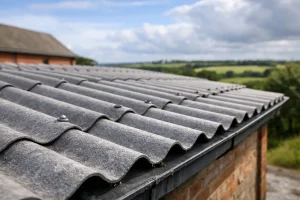
It is worth saying clearly – if sheets are badly corroded, cracked across multiple spans, or have widespread fixing failure, repair may not be the most cost-effective route. Replacing a few accessories is one thing. Trying to rescue a roof that has reached the end of its service life is another.
The most common causes of leaking sheeted roofs
With steel box profile, corrugated and similar systems, failed fixings are one of the biggest causes. Washers compress over time, UV takes its toll, and poorly driven screws can sit at an angle, leaving a path for water. Overtightening is just as bad as undertightening because it can distort the washer and crush the sheet profile.
Sheet laps are another weak point. End laps that are too short, side laps installed without the right lap sealant, or overlaps placed against the prevailing weather can all let wind-driven rain through. This is especially common on low-pitch roofs where water drains more slowly and capillary action becomes more of an issue.
Flashings also deserve attention. Ridge flashings, apron flashings and verge trims are there to finish the roof properly, not just make it look tidy. If they are loose, undersized or fixed badly, water will get behind them. Likewise, cracked rooflights and aged seal strips can turn a weatherproof roof into a leaky one very quickly.
Then there is condensation. On uninsulated roofs, moisture can form on the underside of the sheet and drip like a leak, particularly in garages, stables, workshops and agricultural buildings. If the issue appears mainly in cold mornings rather than after rainfall, you may be dealing with ventilation or anti-condensation control rather than rain penetration.
Repairing leaking fixings and washer failures
If the leak is centred around a fixing point, start by checking whether the screw is loose, corroded or incorrectly seated. Do not simply tighten every fixing on the roof as hard as possible. That often damages more washers than it saves.
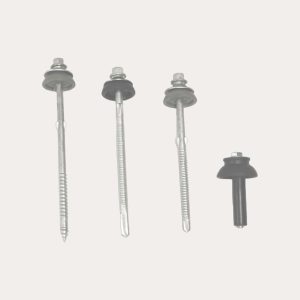
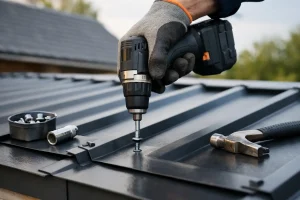
Remove suspect fixings one at a time and inspect the washer. If it is cracked, flattened, split or missing, replace it. If the screw has enlarged the hole or the substrate beneath has lost grip, fit an appropriate oversized replacement fixing designed for the sheet and support below. The replacement needs to bite securely without distorting the sheet.
Where several fixings have failed across one area, it is usually better to replace them systematically rather than treating one leak at a time. A roof that is old enough to have one perished washer often has others close behind. Using the correct fixings matters here. The right stitchers, self-drillers or timber fixings, paired with suitable sealing washers, will give a much more reliable repair than a generic screw from a local hardware shelf.
How to fix leaking roof sheets at overlaps and laps
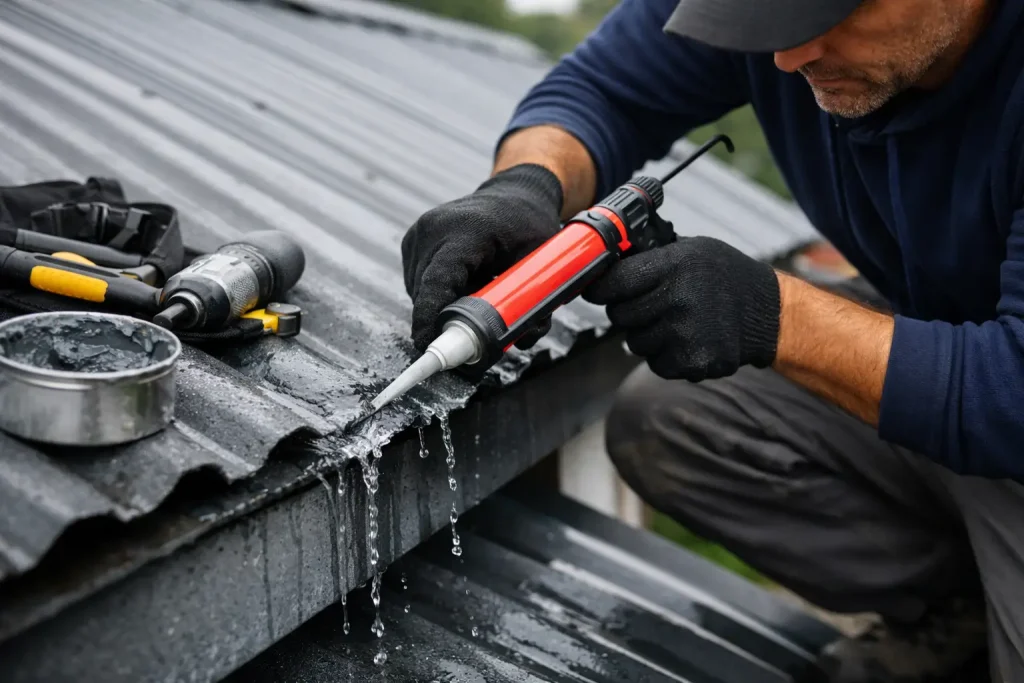
Leaks at side laps and end laps need a bit more care. If the sheets are otherwise in good condition and the laps are accessible, you may be able to lift the overlap carefully, clean out debris, remove failed sealant and apply fresh butyl lap sealant before refixing. Surfaces need to be dry and reasonably clean for this to work.
If the original lap arrangement is wrong for the roof pitch, the repair may only be partial. Very shallow pitches need proper detailing, correct overlap lengths and the right profile choice. On some older roofs, the problem is not just failed sealant but a specification that was marginal from day one. In that case, a more extensive strip and refit of affected sheets may be the sensible route.
Capillary grooves, where present on the sheet profile, should also be checked. If side laps are not seated properly, water can bypass the groove and track inward. This is a fitting issue rather than something a heavy bead of mastic will solve.
Flashings, ridge pieces and rooflight repairs
When water enters near edges, junctions or the ridge, inspect all flashings carefully. Look for lifted edges, missing fixings, failed foam fillers and gaps where wind-driven rain can enter. In many cases the cleanest repair is replacement rather than trying to over-seal a bent or poorly fitted flashing.
A new ridge flashing, barge flashing or apron flashing, made to suit the sheet profile and roof detail, will outperform a patch-and-pray repair every time. The same goes for foam fillers. If they have shrunk, blown out or were never installed, replacing them can make a major difference to weather resistance.
Rooflights are another common weak point, especially on older outbuildings. Cracks around fixings, crazing from UV exposure, and poor lap detailing can all cause leaks. Sometimes the sheet itself is still serviceable but the translucent rooflight section has simply aged out. Replacing the rooflight with a matching profile is usually a better long-term fix than trying to seal over splits.
When sealant helps and when it does not
Sealant has its place, but it is not a substitute for proper sheeting details. Good-quality butyl sealant is useful in laps and around certain flashing details where the system calls for it. What it does not do well is rescue loose fixings, bridge moving joints indefinitely, or compensate for cracked sheets.
If you can move the component by hand, sealant alone will not hold the weather out for long. If the substrate is dirty, wet or rusting heavily, it will fail sooner. Used correctly, sealant is part of the repair. Used as a blanket fix, it is usually just a delay.
Knowing when to repair and when to replace
There is a point where repeated leaks are telling you the roof needs more than maintenance. If multiple sheets are corroded through, the coating has broken down across large areas, fixings are failing throughout, and flashings are mismatched or improvised, replacement often works out better value than ongoing call-backs and patch repairs.
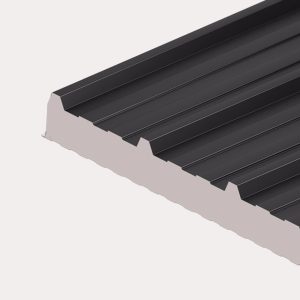
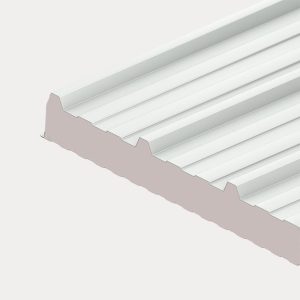
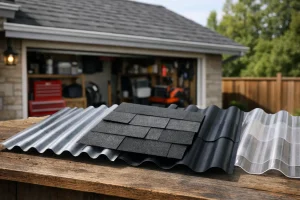
This is especially true if you are already upgrading an outbuilding, improving insulation, or trying to deal with condensation at the same time. A partial refurb with new sheets, matching flashings, fresh fixings, rooflights and closure pieces can transform performance. For trade buyers and capable DIY customers alike, getting all components from one supplier avoids the usual stop-start of chasing missing trims or incompatible fixings halfway through the job.
At Roof Sheets Online, that is exactly where the one-stop approach helps. When the sheets, fixings, flashings, fillers and rooflights are specified together, the repair or replacement stands a much better chance of being weatherproof first time.
Safety and practical planning
Working on a leaking roof is not just a materials question. Fragile rooflights, wet sheets, steep pitches and unsupported spans all create risk. If access is poor or the roof condition is uncertain, bring in a competent roofer. A leak is never worth a fall.
It also pays to plan the repair around weather, access equipment and the full list of parts required. A missing pack of fixings or the wrong flashing profile can turn a one-day repair into a week of temporary covers and further water ingress. Measure carefully, identify the exact sheet profile, and match accessories to the system already on the roof wherever possible.
A dry building starts with the small details being right. If you treat the cause rather than the symptom, leaking roof sheets are usually straightforward to put right – and a lot less likely to trouble you again when the next spell of bad weather comes through.