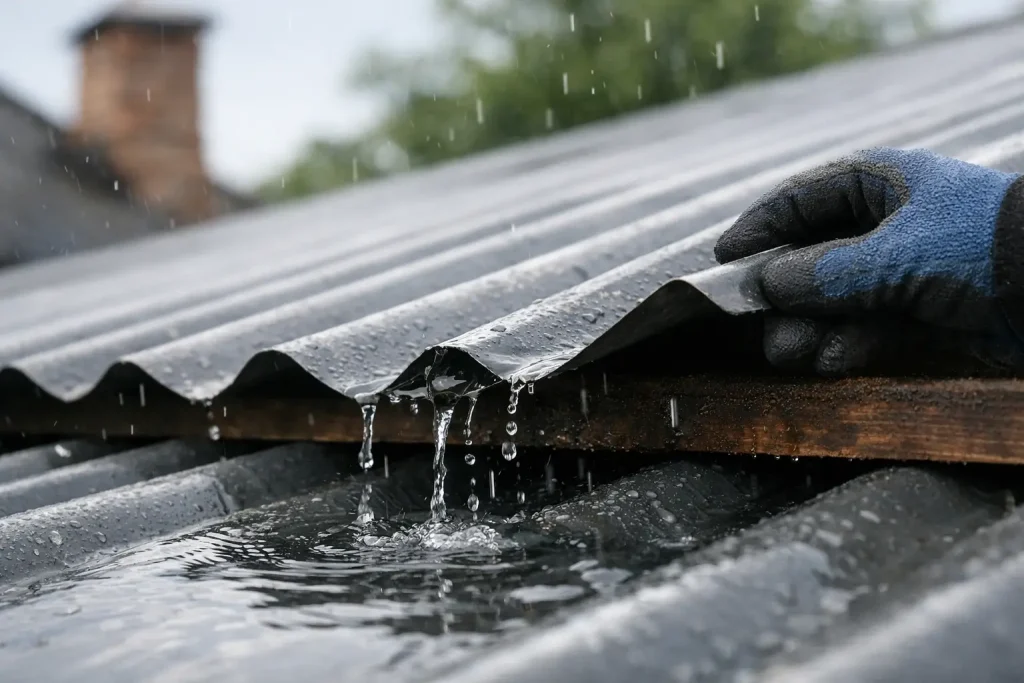
A leak through sheet roofing is rarely just a problem with the sheet itself. When customers ask, why are roof sheets leaking, the cause is often a missed fixing, a poorly supported overlap, ageing sealant or condensation that has been mistaken for rainwater. Find the source first, then fix the detail properly. A quick blob of sealant may slow the drip, but it will not correct a sheet that is moving, an incorrect lap or a failed flashing.
First, make sure it is a roof leak
Before working on the roof, check whether water appears only after rain or whether it is most noticeable on cold mornings and during changes in temperature. Water that forms evenly on the underside of sheets, particularly over a shed, garage, stable or workshop, is commonly condensation. It can run along purlins and drip at joints, making it look exactly like an external leak.
Condensation is more likely where a building has warm, moist air inside, little ventilation and uninsulated metal sheets overhead. Stables, livestock buildings, workshops and garages are frequent examples. Improving airflow at eaves and ridge level, using an anti-condensation backing where suitable, or specifying an insulated roof system can solve the real issue. Sealing every overlap will not stop moisture forming on the underside of a cold roof.
If water appears after wind-driven rain and follows a clear route from above, investigate the external roof covering. Do this safely from ground level where possible. Never walk on unsupported sheets, and use suitable access equipment if close inspection is needed.
Why roof sheets leak at overlaps
Side laps and end laps are designed to shed water, not hold standing water. The profile, roof pitch and direction of the prevailing weather all affect how well they perform. If the sheet is installed with the wrong overlap, or the lap faces into the prevailing wind, rain can be forced beneath it.
A side lap should follow the manufacturer’s guidance for the profile being fitted. Box profile, corrugated and fibre cement sheets all have different lap requirements. On low-pitch roofs, the margin for error is smaller because water drains away more slowly. End laps need particular attention: the upper sheet must overlap the lower sheet sufficiently, with the correct sealing tape where the specification calls for it.
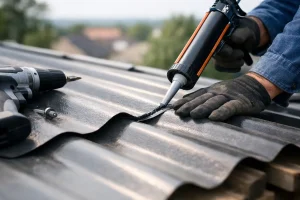
Butyl stitcher tape and lap sealant are useful components when used in the right place. They should be compressed between clean, dry sheet surfaces rather than spread across a wet or dirty joint afterwards. If an overlap has opened because sheets are poorly fixed or purlin spacing is wrong, remove and refit the affected section rather than relying on surface sealant alone.
Fixings are a common weak point
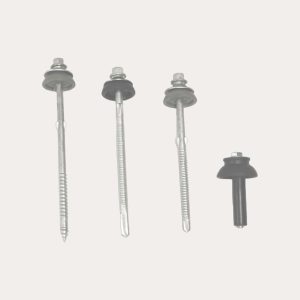
A roofing screw creates a penetration through the sheet, so it must be the right type, in the right position and tightened correctly. Leaks around fixings are particularly common on older roofs and on DIY installations where generic screws have been used.
A proper roofing fixing uses a sealing washer, normally an EPDM washer, that compresses to form a weatherproof seal. Too loose, and the washer does not seal. Too tight, and the washer can distort, split or force the sheet to dimple around the screw. Both can let in water.
Fixings also need to be long enough for the roof build-up and compatible with the supporting structure, whether that is timber or steel. A screw that has missed the purlin may look secure from above but will move under wind load. That movement gradually enlarges the hole and breaks the seal.
Look for cracked washers, rusty screws, lifted screw heads and holes where a fixing has been removed or repositioned. Replace failed fixings with compatible roofing screws rather than putting a larger, unsuitable screw into the same hole. Where a hole is damaged, it may need a purpose-made repair solution or a new sheet, depending on its position and the extent of the damage.
Flashings often cause the leak, not the sheets
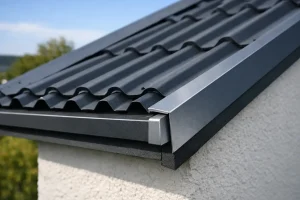
Roof sheets only perform as part of a complete system. Ridge flashings, barge flashings, apron flashings, valleys and sidewall details direct water away from vulnerable edges. If one is missing, too short, poorly lapped or not sealed at the ends, rain can track beneath the roof covering.
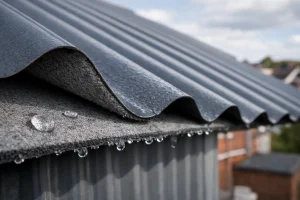
A ridge is a typical example. The ridge flashing must cover both roof slopes adequately and be fixed at appropriate centres. Profile fillers may also be needed to close the gaps created by corrugated or box-profile shapes while still allowing the roof to ventilate as designed. Without the correct closures, wind-driven rain, insects and debris can enter beneath the ridge.
At an abutment, such as where a lean-to roof meets a wall, an apron flashing must turn up the wall and extend down over the sheet profile. The wall chase, sealant and fixing method matter as much as the flashing itself. Water running down brickwork can pass behind a poorly detailed flashing and show up inside several metres from the real entry point.
Check gutters too. A blocked gutter or badly positioned eaves flashing can cause water to back up under the sheet ends during heavy rain. The roof may be sound, but the drainage detail is not doing its job.
Damage, corrosion and sheet movement
Roofing sheets can be damaged by falling branches, foot traffic, impact or years of wind movement. Small punctures and cracks may be difficult to spot, especially in corrugations or around rooflights. On metal roofing, corrosion can develop where protective coatings have been scratched, where incompatible materials touch, or where water and debris sit for long periods.
A repair is viable when damage is isolated, the surrounding sheet remains sound and the repair can be made without trapping water. For widespread corrosion, multiple cracks or severely worn coatings, replacement is usually the more dependable long-term choice. It avoids spending time chasing one leak after another on a roof that has reached the end of its useful life.
Sheet movement deserves attention on long roof slopes. Metal expands and contracts with temperature changes. If sheets are fixed incorrectly, over-tightened or installed without allowing for the system design, this movement can stress fixing holes and laps. Correct purlin spacing and fixing centres keep sheets supported and reduce flexing in wind.
A practical way to trace a leak
Water does not always appear directly below the entry point. It can travel along a sheet rib, a timber rafter, a steel purlin or the underside of a flashing before dripping inside. Start above the visible damp patch, then work uphill towards the ridge.
Check the roof in this order:
- Gutters, eaves and sheet ends for blockages or water backing up.
- Fixing lines for missing, loose, corroded or over-tightened screws.
- Side laps and end laps for gaps, failed tape or incorrect overlap direction.
- Ridge, verge, valley and wall flashings for poor coverage or open joints.
- Sheet faces for punctures, cracks, worn coating and signs of movement.
If the leak only occurs in a particular wind direction, pay close attention to laps, ridges and verges on that exposed side. If it happens after prolonged rain rather than a short shower, suspect shallow pitch, standing water, blocked drainage or a weak end-lap detail.
Preventing future leaks when fitting new sheets
The best repair is often a correctly specified roof system. Choose sheets that suit the roof pitch, building use and expected moisture levels, then order the components that make the system weatherproof: compatible fixings, sealing tapes, flashings, fillers, gutters and suitable purlins. Mixing profiles or improvising trims can create gaps that are difficult to seal reliably.
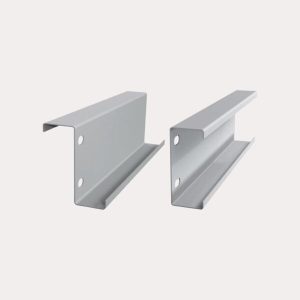
Keep sheets clean during installation, particularly at laps. Follow the product-specific fixing layout and do not guess the overlap distance. Check that the supporting structure is square, level and spaced to suit the sheet gauge and profile. Even premium sheets cannot compensate for purlins that are uneven or too widely spaced.
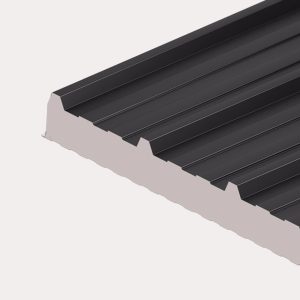
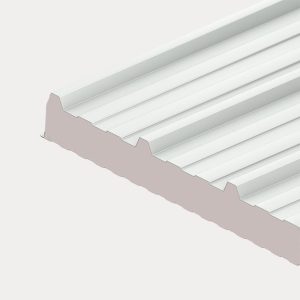
For heated, occupied or high-moisture buildings, consider condensation control at the design stage. Insulated panels such as Kingspan QuadCore systems can be a strong option where thermal performance and internal moisture management matter, while anti-condensation solutions and effective ventilation may suit simpler outbuildings.
A dry roof comes from good sheet material, correct support and the right finishing components working together. If you are unsure whether you need a new flashing, replacement fixings or a complete re-roof, Roof Sheets Online can help you specify the practical components needed to put the job right and keep it weatherproof.