A cold tin roof over a warm workshop can start dripping long before the rain gets going. If you are comparing the best anti condensation roof membrane options, the right choice comes down to more than just price – it depends on your building use, ventilation, roof build-up and how much moisture the space creates day to day.
Condensation is one of the most common problems on metal roofs, especially on garages, agricultural buildings, sheds, stables and light industrial units. Warm, moisture-laden air rises, hits the colder underside of the roof sheet and turns to water. That can lead to dripping, damp stock, mould, corrosion around fixings and a building that never quite feels dry. A membrane can help, but only if it suits the job.
In plain terms, an anti-condensation roof membrane is there to manage moisture before it becomes a visible problem. Some products absorb moisture temporarily and release it later as temperatures and ventilation improve. Others act more as a barrier layer in a built-up roof, helping control vapour movement and reducing the chance of interstitial condensation.
That distinction matters. Buyers often use the word membrane to describe several different products, but they do not all do the same job. If you are ordering roofing sheets for a simple single-skin roof, the membrane option may be a factory-applied anti-condensation fleece on the underside of the sheet. If you are building a more insulated roof, you may be looking at breather membranes or vapour control layers as part of a full system.
The best option is the one that matches the roof design, not the one with the most marketing around it.
For many single-skin metal roofs, this is the most practical answer. A fleece or felt-like anti-condensation layer is bonded directly to the underside of the steel sheet during manufacture. When moisture forms, the material holds it rather than allowing it to drip onto the space below. As conditions change and airflow improves, that moisture can evaporate away.
This option works particularly well on sheds, barns, garages, workshops and other outbuildings where you want the speed and cost-effectiveness of single-skin sheeting but need better condensation control. It keeps installation straightforward because the protection is already part of the sheet, so there is no separate membrane layer to fit underneath.
The trade-off is that it is not a cure for poor design. If the building has high humidity, limited airflow and no insulation, even a good anti-condensation backing can be overwhelmed. It reduces risk rather than making ventilation irrelevant.
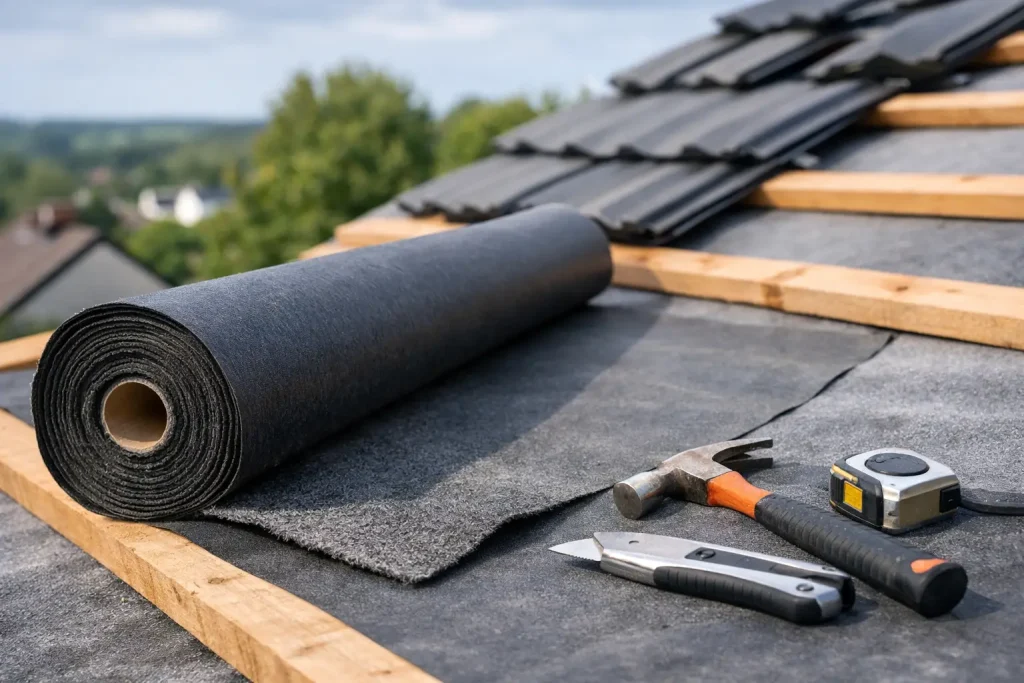
A breather membrane is more common in insulated roof constructions. It is designed to allow water vapour to escape while helping prevent external moisture getting into the roof build-up. Used correctly, it supports the overall condensation strategy of the roof rather than simply absorbing droplets at sheet level.
This type of membrane is useful where insulation is included and where you need the roof to manage moisture movement across several layers. It is not usually the first choice for a basic open-span shed with single-skin cladding, but it can be the right call on more developed buildings, extensions and enclosed workspaces.
Specification matters here. A breather membrane has to be compatible with the rest of the roof system, including insulation, purlins, liner panels and outer sheets where relevant. If the layers are wrong, moisture can still get trapped.
Strictly speaking, a vapour control layer is not the same as an anti-condensation fleece or a breather membrane, but it often enters the conversation for good reason. It sits on the warm side of the insulation and limits the amount of warm moist air entering the roof structure.
For heated buildings, offices within industrial units, garden rooms, or workshops with regular occupancy, this can be one of the most important layers in the whole build-up. It tackles the source of the problem by controlling vapour movement before it reaches colder surfaces.
The downside is that it relies on correct detailing. Poor sealing around laps, penetrations and edges can reduce performance quickly. On a simple agricultural or storage building, it may be more than you need. On a conditioned internal space, it may be essential.
For a standard garden shed or domestic garage with metal roof sheets, fleece-backed sheets are often the best balance of performance, simplicity and cost. They are especially useful where power tools, stored items or vehicles need protection from drips.
If the garage is unheated and only used occasionally, that may be enough alongside sensible ventilation. If it is a workshop with regular use, heaters and closed doors in winter, you may need to think beyond the sheet and look at insulation and vapour control as well.
These buildings often produce a lot of moisture through animals, bedding, wash-down and daily temperature swings. Anti-condensation fleece can work very well here, particularly on single-skin sheeted roofs, because it helps prevent dripping directly onto bedding and feed areas.
That said, agricultural environments can also be demanding on materials. Ventilation design is critical, and the roof system should be chosen with durability in mind, not just condensation control. A cheaper membrane option that fails early in a hard-working building is rarely good value.
This is where specification becomes more dependent on use. A cold storage unit, engineering workshop and insulated trade counter do not have the same moisture profile. If the building is occupied, heated or insulated, a full built-up approach with the correct membrane and vapour control layers will usually outperform a basic absorbent backing.
For simpler units used mainly for storage, anti-condensation-backed steel sheets may still be the most practical route. The right answer depends on what happens inside the building every day.
Start with the roof type. If it is a single-skin metal roof, an anti-condensation fleece-backed sheet is usually the most direct solution. If it is an insulated roof, look at the whole system rather than trying to solve condensation with one layer alone.
Then consider moisture load. A garden store for bicycles creates far less vapour than a stable or busy workshop. The more moisture inside the building, the less sensible it is to rely on a basic membrane alone.
Ventilation is the next check. Even the best anti condensation roof membrane options perform better when the building can actually purge humid air. Ridge ventilation, eaves detailing and general airflow all matter. Without that, moisture has nowhere to go.
Finally, think about installation quality. Membranes and backed sheets only do their job when the roof is fitted correctly, with the right overlaps, fixings, flashings and closures. This is one reason many buyers prefer sourcing the complete roof package from one supplier rather than piecing it together from different merchants.
One of the biggest mistakes is expecting a membrane to compensate for a poorly ventilated building. Another is choosing a product based only on upfront cost, then dealing with damaged stock, staining or retrofit work later.
It is also easy to confuse product categories. A fleece-backed sheet, a breather membrane and a vapour control layer all have their place, but they are not interchangeable. If you are unsure which one your project needs, it is worth checking before ordering rather than after the sheets are on site.
There is also the question of maintenance and use. If a building is likely to shift from cold storage to a more regularly occupied space, the original roof specification may no longer be enough. That is common with garages converted into hobby spaces or farm buildings adapted for other uses.
Best value is not always the cheapest square metre rate. On a straightforward shed or garage, anti-condensation-backed roof sheets often deliver the strongest value because they are quick to install, effective for the application and avoid adding unnecessary build-up.
On a heated or insulated building, value comes from getting the full roof design right first time. Spending a bit more on the correct membrane arrangement can save far more in remedial work, lost time and reduced building performance.
At Roof Sheets Online, that is usually the conversation worth having – not just which product is cheapest, but which roof build will actually perform on your site, with your use case, and with all the trims, fixings and accessories needed to complete it properly.
If you are weighing up anti-condensation options, the smart move is to match the membrane to the building rather than forcing one product into every job. Get that right, and your roof has a much better chance of staying dry, durable and fit for purpose year after year.
Roof Sheets Online Ltd
UNIT C4
MACROME ROAD
Wolverhampton
WV6 9HD
Company No 15150940
Vat No. 4880 70856