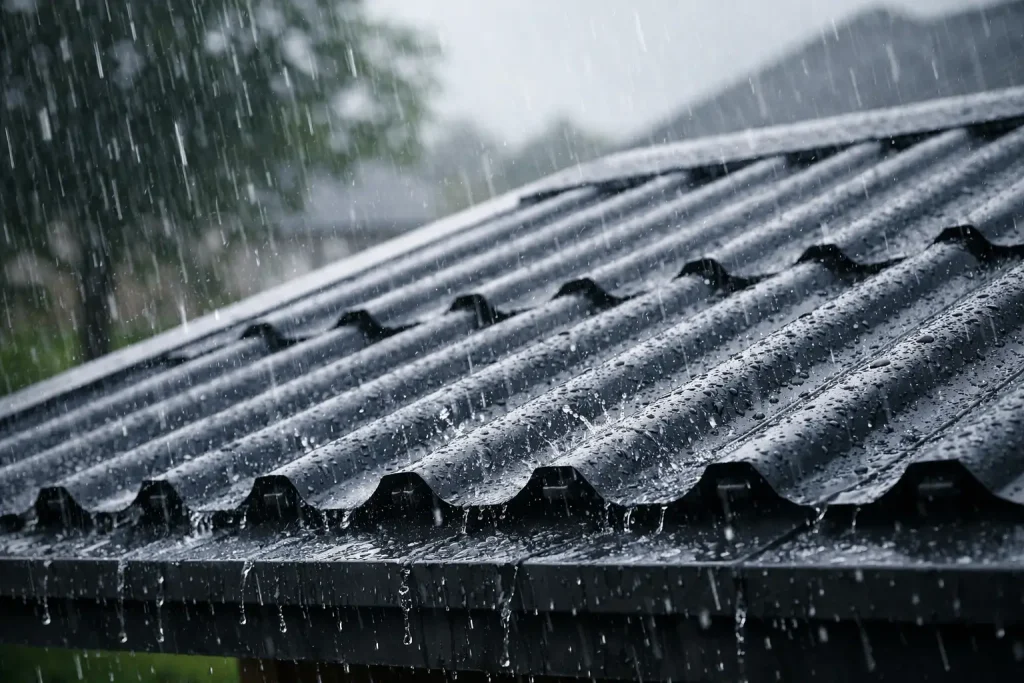
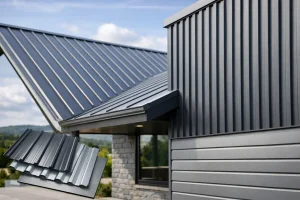
A hard downpour on an unlined garden shed can make any roof sound busy. So, are metal roof sheets noisy in rain? They can be, particularly when sheets are fixed directly over open purlins or timber with no ceiling, insulation or internal lining. But a properly specified metal roof on a garage, workshop, stable or extension does not have to be uncomfortably loud.
The key is to separate the sheet itself from the full roof build-up. Metal is a thin, hard material, so raindrops are more audible when they strike it than when they hit a thick tiled roof. Add insulation, an internal liner and the right fixing arrangement, however, and much of that sound is absorbed before it reaches the room below.
Are metal roof sheets noisy in rain compared with other roofs?
Metal roof sheets generally produce a sharper rain sound than concrete tiles, slate or a felted roof deck. That is most noticeable in lightweight buildings with exposed rafters, such as a basic shed, field shelter, lean-to or open agricultural store. There is little mass in the structure to stop vibration travelling indoors.
This does not mean metal is the wrong choice. Steel roof sheets are sleek, strong and weather-resistant, while their long lengths and low weight make them a practical option for many projects. The rain noise becomes a design consideration rather than a reason to rule out the material.
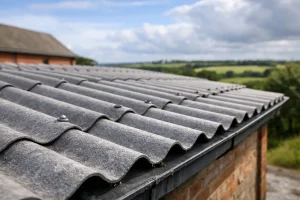
A corrugated profile may create a slightly different note to box profile sheeting because of its shape and stiffness, but profile choice alone will not transform the acoustic performance. The space beneath the sheets, the insulation and whether the roof has a ceiling make a far bigger difference.
Why an uninsulated metal roof sounds louder
Rain striking a roof sheet creates a small vibration. On an uninsulated roof, that vibration can pass into the air beneath the sheet and be heard inside. The effect is amplified where there is a large hollow void, particularly if walls and floors are also hard surfaces.
Several installation details can make the issue more noticeable. Wide purlin spacing can leave more of the sheet unsupported between fixings, allowing greater movement. Loose or incorrectly positioned fixings can cause rattling in strong wind and rain. A roof with open eaves or gaps around flashings may also let external sound enter directly.
Heavy rain and hail will always be heard to some degree. Anyone fitting a bare steel roof over a simple storage building should expect that. For a workspace, office, converted garage or stable where people spend long periods indoors, it is worth spending time on the complete specification before ordering.
Insulation makes the biggest difference
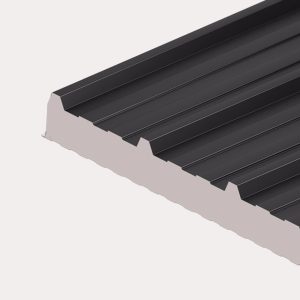
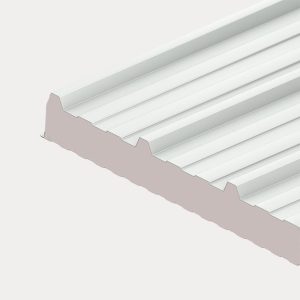
Insulated composite roof panels are the most straightforward route to a quieter metal roof. These panels combine an external steel weather sheet, a high-performance insulated core and an internal liner in one precision-made system. The insulated core reduces heat loss and helps dampen sound, while the internal liner gives the underside a finished appearance.
For heated workshops, commercial units, extensions and buildings where condensation control matters, insulated panels often make more sense than building up a cold roof from separate layers. They provide a fast, tidy installation and help improve year-round comfort, not just noise levels.
A built-up roof can also perform well. This usually includes an outer metal sheet, insulation quilt or rigid insulation, vapour control measures where required, and an internal liner panel or ceiling. It offers flexibility, but every layer must be correctly selected and installed. Missing tapes, poorly sealed laps or an unsuitable condensation-control approach can compromise both thermal performance and the roof’s service life.
If the project already has a ceiling, placing mineral wool insulation above it can make a substantial difference to rain noise. The ceiling adds mass, while the insulation absorbs airborne sound in the void. This is often a sensible upgrade for a garage or outbuilding being converted into a more usable space.
Anti-condensation fleece is not acoustic insulation
Many metal roof sheets are available with an anti-condensation fleece bonded to their underside. This felt-like layer captures moisture that would otherwise form as droplets on the cold sheet, then releases it as ventilation conditions improve. It is a useful condensation-management product for suitable uninsulated buildings.
It should not be specified as a substitute for proper insulation or a lined ceiling. It may soften the sound slightly, but its main purpose is moisture control. If a customer wants a noticeably quieter roof, an insulated panel or a properly designed insulated build-up is the better answer.
Practical ways to reduce rain noise under metal sheets
For a new roof, decide first how the building will be used. A machinery store has different requirements from a home workshop, and a stable has different ventilation needs from a garden office. Matching the roof system to the use of the building prevents costly changes later.
The following measures work together to reduce noise:
- Use insulated composite panels where internal comfort, heat retention and a clean internal finish are priorities.
- Add a ceiling and acoustic or mineral wool insulation below single-skin sheets where the structure allows.
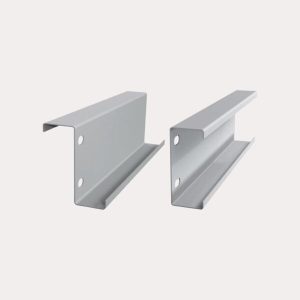
- Ensure sheets are supported at the correct purlin centres for their gauge, profile and roof loading.
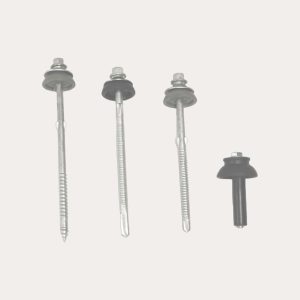
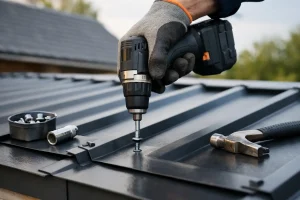
- Use the correct colour-matched roof fixings with sealing washers, fixed in the right locations without over-tightening.
- Fit flashings, fillers and closure components properly to prevent gaps that admit wind-driven rain and outside noise.
The last two points matter more than they may appear. A sheet that is securely fixed to a sound supporting structure is less likely to vibrate, chatter or flex unnecessarily. Correct trims and fillers also finish the roof properly, improving weather resistance as well as the building’s overall feel.
Single-skin sheets still have a place
Single-skin box profile and corrugated sheets remain an excellent choice for many agricultural, storage and outdoor projects. They are cost-effective, quick to install and available in durable finishes suited to British weather. For an open-sided shelter, a detached store used occasionally or a simple timber shed, the sound of rain may be of little consequence.
There is a trade-off. A lower initial material cost can mean a noisier and colder building if the roof is left unlined. If there is any chance that the space will become a hobby room, workshop or animal accommodation, it is wise to plan for insulation, ventilation and a lining from the outset.
Metal sheets also need the right roof pitch, overlaps and supporting structure. A quiet roof is no use if water cannot drain correctly or if the supporting members are undersized. The sheet profile, coating, gauge, purlin arrangement, fixings and flashings should be considered as one weatherproof system.
Choosing the right roof build-up for your project
For a basic shed or log store, single-skin steel sheets with suitable fixings and flashings are usually sufficient. Some rain noise is normal, but the roof will be durable and low maintenance when fitted correctly.
For a garage or workshop used regularly, a lined and insulated roof is worth considering. It provides a more comfortable environment in winter, reduces overheating in warmer weather and makes heavy rain far less intrusive. A ceiling beneath single-skin sheets can be a practical route where insulated panels are not being used.
For offices, extensions, stables, commercial units and higher-specification agricultural buildings, insulated roof panels are often the stronger long-term choice. They offer excellent thermal performance, a professional internal finish and a more controlled acoustic environment. Ventilation and condensation details should still be designed properly, especially in buildings with livestock, machinery or high moisture levels.
Get the specification right before the sheets arrive
The best way to avoid a noisy roof is to order the right system at the beginning, rather than trying to silence a bare roof after it is fitted. Think about how often the building will be occupied, whether it will be heated, what sits below the roof and whether an internal finish is required.
Roof Sheets Online can help customers match sheets, insulated panels, purlins, fixings, flashings and closure components to the job, so the roof arrives as a complete system rather than a collection of parts. If rain noise, condensation or insulation is a concern, raise it before ordering – a few straightforward choices at specification stage can make the finished building far more comfortable for years to come.