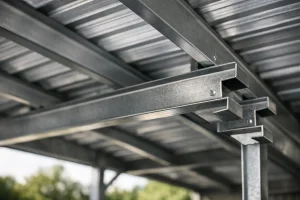
A metal roof should not need constant attention, but it should never be ignored. A loose fixing, blocked valley or split seal can let water travel beneath otherwise sound sheets, where the damage is harder and more expensive to put right. This metal roof maintenance checklist is designed for sheds, garages, workshops, stables, agricultural buildings and light commercial roofs across Great Britain.
The good news is that most checks are straightforward. The key is to inspect safely, act before weather gets in, and use components that match the sheet profile and roof system already in place.
When to inspect a metal roof
Plan a visual check twice a year: once in spring, after winter weather has passed, and again in autumn before leaves, frost and heavy rain arrive. It is also worth inspecting the roof after a named storm, high winds or a period of heavy snowfall.
A ground-level inspection with binoculars can reveal plenty, particularly on a single-storey garage or outbuilding. If you need to access the roof, use suitable access equipment and follow safe working procedures. Metal sheets become extremely slippery when wet, frosty or covered in algae. Never walk directly on unsupported sheet areas, rooflights or fragile fibre cement panels. Where access is required, work from properly supported walkways or bear only over purlins in line with the installation guidance.
Metal roof maintenance checklist: start with the roof surface
Begin by looking for changes rather than assuming every mark is a fault. A well-fitted coated steel roof can cope with years of rain, sun and temperature changes, but scratches, debris and standing water deserve attention.
Check the sheets for dents, punctures, lifted edges, deep scratches and areas where the coating has worn away. Small scuffs may be cosmetic, particularly on an older roof, but exposed steel can eventually corrode if moisture reaches it. Treat minor coating damage with a compatible touch-up system where appropriate, rather than applying an unsuitable household paint that may not adhere or match the roof finish.
Pay particular attention to overlaps. Side laps, end laps and roof-to-wall junctions are natural points for water to test. If an overlap has opened, moved or appears to be holding debris, investigate the cause. It may be a failed fixing, wind movement, inadequate support beneath the sheet or a detail that was not sealed correctly when installed.
On shallow-pitch roofs, look carefully for pools of water after rainfall. Standing water does not always mean the sheet has failed. It can point to insufficient fall, a blocked outlet or purlins that have moved. The remedy depends on the cause, so avoid simply adding sealant over the top and hoping for the best.
Check fixings, washers and sheet movement
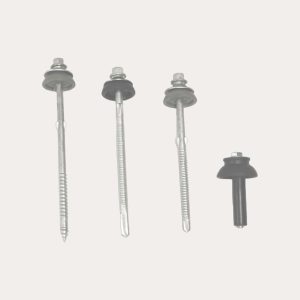
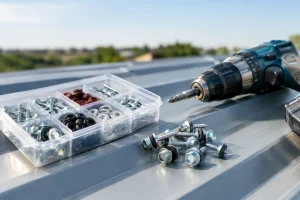
Fixings are small components with a big job. Each one helps hold the sheets against wind uplift and keeps water out at the penetration point. Check for missing screws, screws sitting proud of the sheet, loose fixings, rust staining and perished or flattened sealing washers.
A fixing that is overtightened can crush the washer and deform the sheet. One that is too loose may allow water to track down the shank. Replace failed fixings with the correct type, length and washer for the substrate – timber, steel purlin or another support – rather than using general-purpose screws from the toolbox.
Look along the line of the sheets for rippling, lifting or unusual movement. This can be more noticeable after strong winds. It may mean that a number of fixings have lost their grip, especially on older roofs where the timber beneath has deteriorated. If sheets are lifting at an edge or lap, arrange repairs promptly. Wind can turn a localised issue into widespread damage very quickly.
Clear gutters, valleys and drainage routes
Blocked drainage is one of the most common avoidable causes of leaks. Leaves, moss, nesting material and general debris can build up in gutters and valleys, forcing water back beneath flashings or over gutter edges.
Clear the guttering and check that outlets, downpipes and gully connections run freely. While doing so, inspect brackets and joints for sagging, cracks or leaks. A gutter that has pulled away from the eaves may allow water to soak fascia boards, wall cladding or the ground around the building.
Valleys need particular care because they handle water from two roof slopes. Remove debris without using sharp tools that could scratch the coating. If there is repeated build-up from nearby trees, more frequent cleaning is usually a better answer than waiting for the six-month inspection.
Inspect flashings, closures and seals
Flashings finish the vulnerable edges of a roof: ridges, verges, valleys, abutments and roof-to-wall details. They should sit securely, direct water away from openings and allow for normal movement in the roof system.
Check that ridge and barge flashings are firmly fixed and have not lifted in the wind. Examine apron flashings where a roof meets brickwork or cladding, as well as pipe penetrations and vents. Cracked sealant, detached foam fillers and gaps at profiled sheet ends can all become leak paths.
Not every visible gap needs to be filled with mastic. A roof needs correctly designed ventilation and drainage paths, and excessive sealant can trap water or conceal a bigger fitting problem. Use the right profiled fillers, tapes and flashings for the sheet profile. Box profile, corrugated and wave tile sheets all require details that fit their shape properly.
Look underneath for condensation and early leaks
The underside of the roof often tells a clearer story than the external surface. On a dry day, inspect the inside for damp patches, rusty fixing points, stained purlins, wet insulation or drips around laps and penetrations.
Condensation and a roof leak can look similar, but they need different remedies. Condensation tends to appear across larger areas during cold weather, especially in poorly ventilated sheds, stables and workshops. A leak is more likely to be localised around a fixing, lap, flashing or penetration and may worsen after rain from a particular direction.
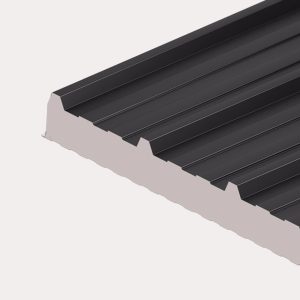
If condensation is the issue, consider ventilation, insulation and anti-condensation measures as a complete system. Adding insulation without managing vapour control and airflow can move the problem elsewhere. For insulated panels, inspect joints, cut edges and seals as part of the check, because damaged joint details can affect both weather resistance and thermal performance.
Keep cleaning sensible
Wash off loose dirt when it starts to hold moisture against the roof, particularly beneath overhanging trees or near coastal locations. Use clean water, a soft brush and a mild cleaner suitable for the sheet coating. Rinse thoroughly.
Avoid abrasive pads, strong solvents and pressure washing at close range. These can damage the protective finish, drive water into overlaps and disturb seals. Do not mix different metals carelessly either. Copper, lead, untreated steel and aluminium can create corrosion risks when water carries deposits between incompatible materials.
Know when a repair needs a professional
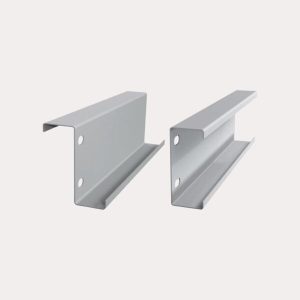
Some jobs are suitable for a competent property owner, such as clearing gutters or replacing an obviously failed fixing from safe access. Others call for an experienced roofer or cladding installer. Seek help where sheets have blown loose, structural supports appear damaged, corrosion is widespread, rooflights are cracked, or a leak cannot be traced without lifting sheets.
Keep a brief record of inspections, photographs and repairs. It helps identify recurring faults and gives a contractor useful information if further work is needed. It also makes ordering replacement sheets, matching flashings or compatible fixings far more accurate.
For replacement materials, do not guess at the profile, coating or fixing specification. A clear photo, sheet measurements and details of the support beneath will usually make selection much simpler. Roof Sheets Online can help customers match the right sheets and supporting components, so a small repair does not become a compromise at the next spell of bad weather.
A roof that is cleaned, checked and repaired at the right time will keep doing the job it was built for: staying strong, weather-resistant and dependable when the British weather turns.