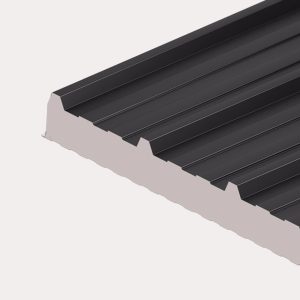
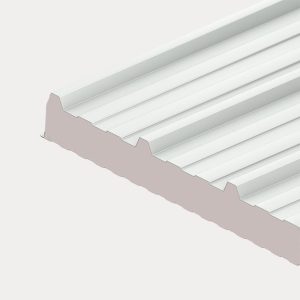
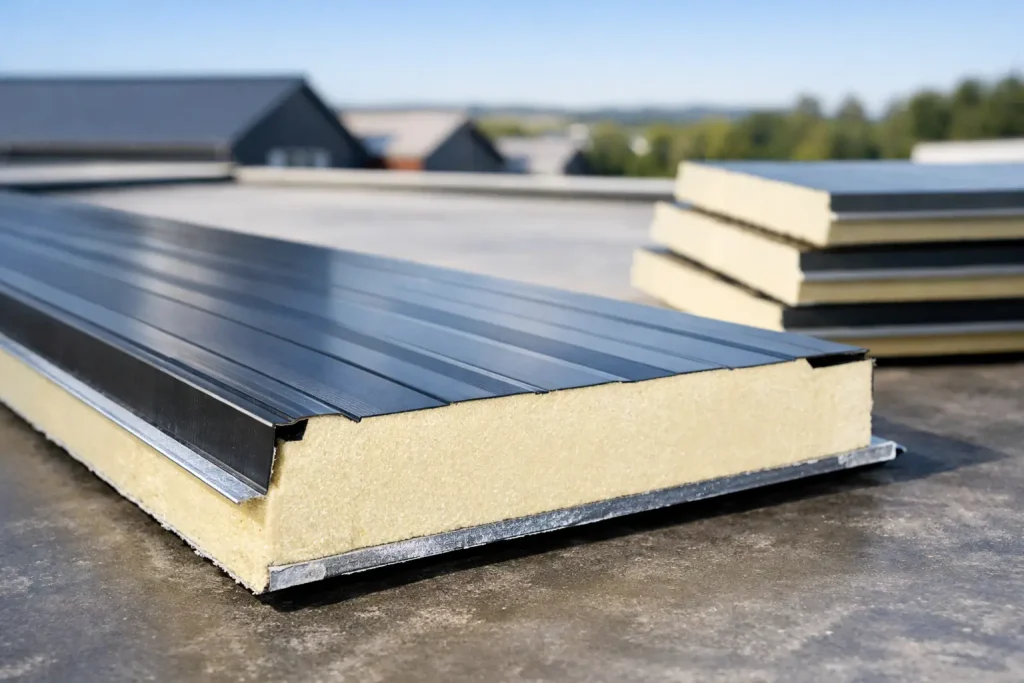
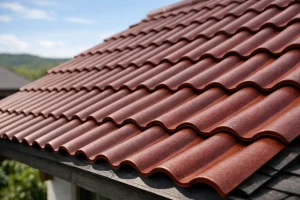
If you are pricing a new roof for a workshop, garage, agricultural building or commercial unit, the panel choice will affect far more than the look of the finished job. Quadcore insulated roof panels 100mm sit in the sweet spot for many UK projects because they balance thermal performance, structural practicality and installation speed without pushing the roof build-up into awkward territory.
For trade buyers, that usually means fewer compromises on compliance and a cleaner install. For homeowners and smallholders, it often means a roof that feels immediately more solid, quieter in bad weather and cheaper to heat over time. The key is knowing where 100mm works well, and where another thickness may be the better call.
Why choose quadcore insulated roof panels 100mm?
A 100mm insulated panel is popular for a reason. It gives a noticeable step up from thinner insulated sheets, but it is still manageable on a wide range of everyday builds. That makes it a practical choice for outbuildings, refurbishments, garden rooms, farm structures, light industrial units and extensions where thermal efficiency matters but the roof design still needs to stay straightforward.
QuadCore technology is designed to deliver strong thermal performance from a slim panel profile. In real terms, that helps you get more insulation value without having to jump straight to a much thicker roof build-up. Where internal headroom matters, that can be a real advantage.
It is not only about insulation, either. Buyers usually choose this panel type because they want one roofing system that covers weather resistance, internal finish, speed of installation and long-term durability. A well-specified insulated roof panel can reduce the need for additional layers and helps simplify the job on site.
What 100mm means in practice
When customers ask whether 100mm is enough, the honest answer is that it depends on the building use. For a heated workshop, commercial unit or insulated outbuilding, 100mm is often a strong, sensible specification. It gives solid performance without making detailing around trims, flashings and roof junctions more difficult than it needs to be.
For an unheated agricultural shelter or basic storage building, 100mm may be more than enough. For spaces that are occupied daily or expected to hold heat well in winter, it can still be right, but the wider roof build-up and overall building design need to be considered too. Walls, ventilation, openings and installation quality all affect the final result.
That is where a lot of projects go wrong. Buyers focus on the panel thickness alone, when the finished roof only performs properly if the fixings, laps, flashings, sealants and supporting structure are all specified correctly.
Thermal performance and energy savings
The main reason people move to quadcore insulated roof panels 100mm is thermal efficiency. Better insulation helps stabilise internal temperatures, cuts heat loss and can improve running costs in buildings that are heated regularly.
That matters for more than large commercial jobs. A home workshop, garage conversion or equestrian building with insulated roofing will usually be more comfortable to use all year round. In summer, the internal space is less likely to become unbearable. In winter, it takes less energy to hold a workable temperature.
There is also the issue of condensation. Single-skin metal sheets are fine in the right setting, but in occupied or temperature-sensitive buildings they can create problems if warm internal air meets a cold roof surface. Insulated panels help reduce that risk because the internal face is less exposed to sharp temperature swings. That does not remove the need for sensible ventilation, but it does give you a far better starting point.
Strength, finish and weather resistance
A roof panel needs to do more than hit a thermal target. It has to stand up to British weather, repeated temperature changes and the wear that comes with time. Good insulated panels are built to be sleek, strong and weather-resistant, which is exactly what buyers want when they are putting money into a roof they expect to last.
The external finish matters here. Depending on the building and setting, buyers may want a coating that offers strong corrosion resistance, better colour retention or a finish suited to harsher environments. Internal liner finish matters too, particularly in workshops, agricultural settings and commercial units where a clean, bright underside is useful.
On exposed sites, wind uplift and fixing detail become just as important as the panel itself. A premium panel still needs the correct fasteners, support centres and perimeter detailing if it is going to perform properly in poor weather.
Best uses for 100mm insulated roof panels
For many projects, 100mm is the practical middle ground. It works especially well on garages, garden buildings, workshops, stables, storage units, plant rooms and light industrial roofs where insulation is required but the structure is not designed around very thick panels.
It also suits refurbishment work where the aim is to upgrade an older roof to something more thermally efficient and easier to maintain. If the existing building is being brought into more regular use, switching from basic metal sheeting to insulated panels can transform how usable the space feels.
That said, not every roof should default to 100mm. If the building is rarely occupied and heating is not a factor, a thinner option may be more cost-effective. At the other end, if the project has tighter thermal targets or is expected to perform more like a highly insulated occupied building, a thicker panel could make better sense.
Installation matters as much as the panel
One of the big selling points of insulated roof panels is speed. Compared with building up multiple roofing layers separately, they can make installation quicker and cleaner. That is good for labour time, programme planning and getting a building watertight without delay.
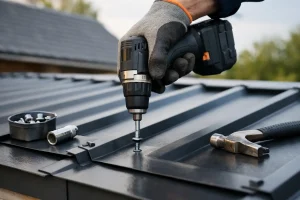
Even so, insulated panels are not a product to fit casually. Setting out needs to be right from the start. Support spacing, panel direction, side laps, end laps, ridge details and rooflight integration all need proper attention. A rushed installation can undermine the benefit of buying a premium panel in the first place.
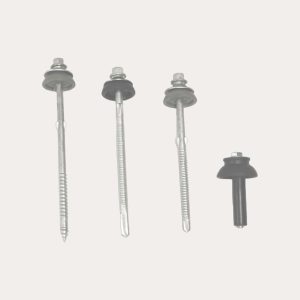
Accessories are part of the system, not an afterthought. Fixings, stitchers, flashings, fillers and sealing tapes all play a part in weatherproofing and long-term performance. Sourcing everything from one specialist supplier is often the easiest way to avoid mismatched components and delays on site.
What to check before you buy
The right panel is never just about thickness. Before ordering, it is worth checking the roof pitch, span requirements, expected building use, finish specification and whether rooflights or penetrations are needed. Delivery planning matters too, especially on jobs where access is tight or the site programme leaves little room for error.
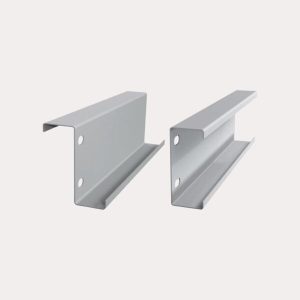
Trade customers will often know the profile, coating and lengths they need. Less technical buyers usually need a bit more guidance, and that is perfectly normal. The most efficient route is to sort the full roof package at the same time – panels, flashings, fixings, purlins and trims – rather than trying to piece the system together later.
If you are buying online, support still matters. A supplier that can confirm availability, talk through the specification and help with the accessory list saves time and reduces costly mistakes. That is particularly useful on insulated roofing, where ordering the panel is only part of getting the job right.
Are quadcore insulated roof panels 100mm worth it?
For plenty of UK roofing projects, yes. They offer a strong mix of insulation, build quality and fast installation, and they suit a wide range of domestic, agricultural and commercial applications. They are especially good where you want a precision-crafted, weatherproof roof that performs well through the seasons and looks professional when finished.
The trade-off is upfront cost. Insulated panels are a bigger initial investment than basic single-skin sheeting. But when you factor in thermal performance, condensation control, reduced build-up complexity and long-term durability, the value often stacks up quickly.
At Roof Sheets Online, we see this choice made every day by customers who want dependable roofing without overcomplicating the order. If you are weighing up 100mm panels for your next project, the best move is to match the specification to how the building will actually be used – then make sure every fixing, flashing and trim is part of the plan from day one.
A roof always looks simple once it is finished. Getting there is easier when the panel, the accessories and the advice all come from people who know what works.