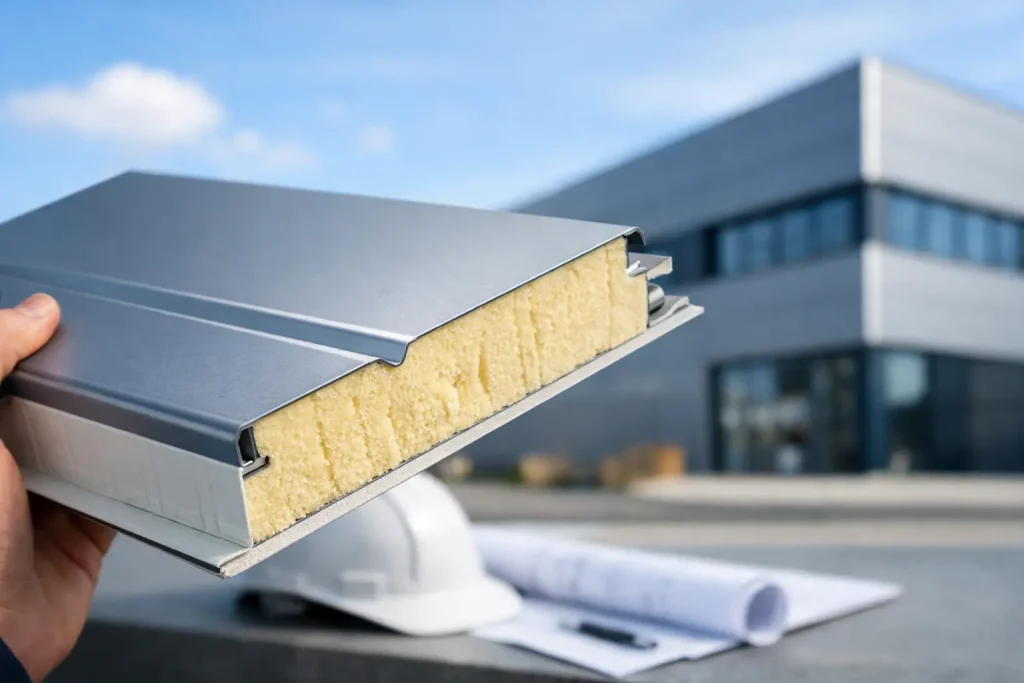
If you are pricing an insulated roof or wall build, a guide to Kingspan QuadCore panel specification quickly becomes less about brochure figures and more about getting the panel right for the job. A workshop, stable block, farm building, warehouse extension or garden room can all need very different answers on thickness, span, fire performance, finish and fixing details. Get the specification right first time and the rest of the build tends to run smoother.
A panel specification is not just a product description. It is the set of performance details that tells you whether a panel is suitable for the building, the environment and the way it will be installed. With Kingspan QuadCore insulated panels, that usually means looking at thermal performance, fire performance, structural capability, weather resistance, panel joint design, available lengths, face finishes and the supporting components needed to install the system properly.
For trade buyers, that is about compliance, performance and avoiding call-backs. For homeowners and smallholders, it is about buying once and buying right. Either way, the specification matters because insulated panels are a system product, not just a sheet with insulation inside.
The first thing to pin down is whether you are specifying for a roof or a wall. Roof panels and wall panels may look similar at a glance, but they are designed for different loading conditions, drainage requirements and joint details. A roof panel needs to deal with water run-off, roof pitch, snow load and foot traffic during installation. A wall panel needs to manage wind loading, weather tightness on vertical runs and visual appearance.
That sounds obvious, but it is where plenty of projects start to drift. A buyer may focus on insulation value alone, then find later that span capability, finish choice or panel orientation changes the practical specification.
Thickness is usually the first question, and rightly so. Thicker panels generally deliver better thermal performance, but they also affect cost, detailing around openings and how the whole build comes together. If you are building a heated workshop or commercial unit, lower U-values may be a priority. If you are roofing an agricultural outbuilding or an unheated store, you may have more flexibility.
Kingspan QuadCore panels are chosen largely because they offer strong thermal performance for their thickness. That can help where space is tight or where you want to keep the roof build-up efficient without overcomplicating junctions. Still, there is no universal best thickness. It depends on the target U-value, the building use and whether the roof or wall has to meet a particular specification from Building Control, a client or an insurer.
If cost is the main driver, there is always a balancing point. Going thinner can reduce the panel price, but it may weaken overall thermal performance and affect running costs over time. Going thicker improves insulation, though it may be more panel than the project really needs.
Fire performance is one of the biggest reasons buyers step up to a branded insulated panel system. On many commercial, agricultural and industrial projects, this is not an optional extra. The panel specification should be checked carefully for reaction to fire, external fire performance and any relevant system test data.
What matters here is using the exact panel type as specified, not assuming all insulated panels perform the same. They do not. Core composition, facings, joint design and installation method all affect real-world results. If your project has insurer requirements or sits near boundaries, openings or other structures, the fire side of the specification deserves proper attention early on.
Span capability is where paper specifications meet site reality. A panel may look ideal on price and insulation value, but if it cannot span your support centres under the required loads, it is the wrong panel for the job. Roof spans need to account for imposed loads such as snow, maintenance access and local exposure. Wall spans need to handle wind loading, building height and orientation.
This is one of those areas where there is no benefit in guessing. Span tables and load data need to line up with the actual project conditions. A small domestic garage in a sheltered part of the country is different from an exposed coastal unit or a larger agricultural building. The panel thickness, support spacing and fixing pattern all work together.
Beyond insulation and span, the finer details are often what decide whether a build goes together cleanly or becomes a snagging exercise.
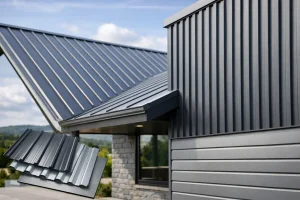
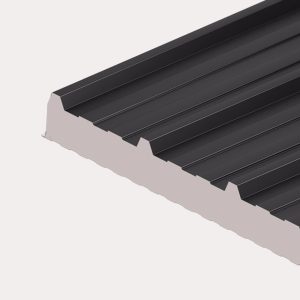
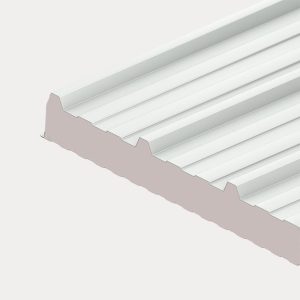
Panel facings affect durability, appearance and suitability for the environment. In standard commercial settings, a durable coated steel finish may be all that is needed. In harsher environments, such as agricultural buildings with higher internal moisture or corrosive conditions, finish choice matters more.
Colour selection is not just cosmetic either. Darker external colours can influence heat absorption, and some projects need a cleaner visual finish for customer-facing or office-adjacent elevations. Internal liner colours and finishes may also matter where light reflectivity or wash-down practicality is part of the brief.
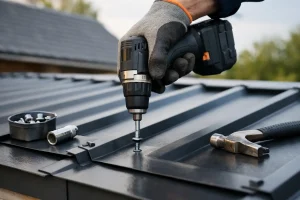
A good insulated panel system should deliver a tight, dependable envelope when installed correctly. That means looking at panel joint design, side lap sealing, end laps where required, and the accessories used around ridges, eaves, verges, corners and openings. The panel alone does not create a weatherproof building. The system does.
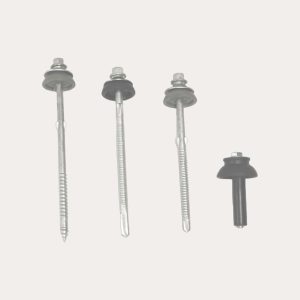
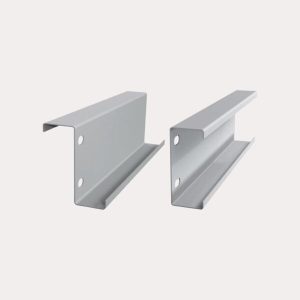
This is where one-stop supply makes practical sense. If the flashings, fixings, fillers, tapes and trims are specified alongside the panel, there is less risk of mixing incompatible parts or missing key details on site. It saves time, and it usually saves money compared with sorting problems once installation has started.
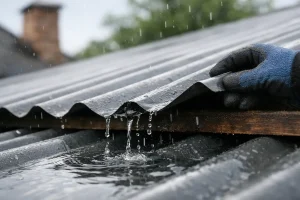
For many buyers, especially on sheds, stables, workshops and farm buildings, condensation is the issue that drives the move to insulated panels. A proper insulated specification helps control internal surface temperatures far better than a basic single-skin sheet. That said, condensation control is not achieved by panel choice alone.
Ventilation, internal humidity levels, airtightness around openings and correct installation all play a part. If the building use creates a lot of moisture, such as livestock, wash-down areas or intermittent heating, the wider design still needs attention. Insulated panels help a great deal, but they are not a cure for every moisture problem in isolation.
The best approach is to start with the building use, not the panel brochure. Ask what the building needs to do over the next ten to twenty years. Is it heated or unheated? Does appearance matter? Is the site exposed? Are there insurance or fire requirements? What support centres are already fixed by the frame design? Will there be rooflights, doors, service penetrations or future alterations?
From there, the right specification becomes clearer. A small private workshop may need a different balance of performance and budget than a trade unit, food-related building or livestock structure. Some customers genuinely need higher performance across the board. Others need a sensible, reliable panel that meets the brief without overspending.
That is often where practical supplier support matters most. A straightforward conversation about panel use, lengths, flashings, fixings and support details can prevent expensive ordering errors. At Roof Sheets Online, that is part of the value – getting the right materials together, not just shifting panels.
One common mistake is choosing on thickness alone. Thicker is not automatically better if the panel does not suit the structural layout, detailing or budget. Another is comparing non-like-for-like products purely on headline thermal figures while ignoring fire classification, coatings or joint performance.
It is also easy to overlook accessories. A premium insulated panel paired with the wrong fixings, inadequate flashings or missing seals is not a premium roof or wall system once it is on site. Finally, buyers sometimes forget lead times and delivery practicalities. Long-length panels need sensible handling, access planning and offloading arrangements.
Some projects need more than a quick product match. If the building is in an exposed location, has unusual spans, includes high humidity use, or must satisfy a more demanding fire brief, the specification should be checked carefully before ordering. The same applies if the panels are part of a refurbishment rather than a new build, because tie-ins to existing structures can complicate detailing.
That extra bit of attention early on is usually what protects the budget later. A clean specification means fewer delays, fewer substitutions and less site improvisation.
If you are weighing up thickness, spans, finishes and the accessory package, treat the panel as part of the whole envelope rather than a stand-alone product. That is the simplest way to end up with a roof or wall system that looks right, performs properly and arrives ready to fit.
Roof Sheets Online Ltd
UNIT C4
MACROME ROAD
Wolverhampton
WV6 9HD
Company No 15150940
Vat No. 4880 70856